


May 27, 2026
.webp "Assessment and Control of Leachable Impurities in Pharmaceuticals")
Extractables and leachables (E&L) are a critical but often overlooked class of impurities in pharmaceutical development. These compounds can migrate into drug products from packaging systems, manufacturing components, or delivery devices, potentially impacting drug product quality, stability, and most importantly, patient safety.
As global regulatory expectations evolve, systematic extractables and leachables assessment has become an essential part of pharmaceutical development programs. The International Council for Harmonisation (ICH) has introduced the ICH Q3E guideline, which brings a harmonized, risk-based framework for identifying, qualifying, and controlling these impurities across regions.
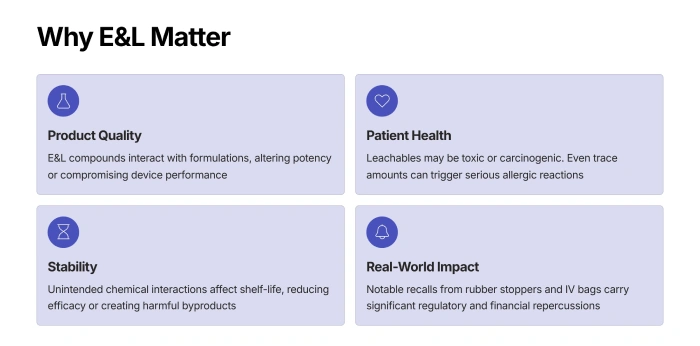
In pharmaceutical systems, materials such as polymers, elastomers, glass, and metals are used in packaging and delivery systems. These materials often contain additives like plasticizers, stabilizers, lubricants, and antioxidants.
Under certain conditions, these substances may migrate into drug products. Extractables are compounds that can be released under aggressive laboratory conditions, while
leachables are compounds that actually migrate into the drug product under normal storage or use conditions.
Because these compounds can impact safety, efficacy, or stability, E&L risk assessment in pharmaceuticals is now a key regulatory expectation.
Potential sources of leachables in pharmaceutical packaging include:
Risk depends on multiple factors, including contact time, temperature, formulation type, surface area, and route of administration.
The ICH Q3E guideline for extractables and leachables emphasizes a structured, risk-based strategy. Products are evaluated based on exposure risk, formulation type, and patient administration route.
For example, parenteral and inhalation products are considered high risk due to direct systemic exposure, while oral solid dosage forms generally carry lower risk due to reduced interaction with packaging materials.
This risk-based classification helps determine the depth and scope of analytical testing required.
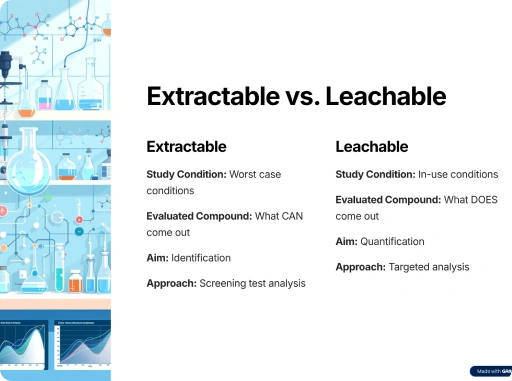
An effective extractables study design uses aggressive laboratory conditions to identify potential migrating compounds. These may include elevated temperatures, strong solvents, and extended exposure times.
Common techniques include Soxhlet extraction, reflux extraction, sonication, and sealed vessel extraction. Multiple solvents with different polarities and pH are used to simulate worst-case conditions and maximize detection of potential leachables.
A key concept in E&L analytical testing is the Analytical Evaluation Threshold (AET). This defines the level above which compounds must be identified and assessed for safety.
Closely linked is the Analytical Uncertainty Factor (AUF), which accounts for variability in semi-quantitative methods where reference standards may not exist for every compound. Together, these ensure that extractables and leachables analysis remains sensitive and conservative from a patient safety perspective.
While extractables studies simulate worst-case scenarios, leachables studies in pharmaceuticals are conducted under real storage conditions using final packaged drug products. These studies identify compounds migrating during shelf life, quantify known and unknown leachables, and support toxicological risk assessments. They also inform stability and regulatory submissions. This ensures a complete understanding of how packaging materials behave over time.
Any leachables detected above AET must undergo a toxicological safety assessment. Approaches such as Threshold of Toxicological Concern (TTC) help define acceptable exposure levels based on route and duration of administration.
If compounds exceed safety thresholds, deeper evaluation is required, including structure–activity analysis and literature review.
A robust E&L control strategy is not a one-time activity. It spans the full product life cycle, typically including the following steps:
1. Risk assessment of materials
2. Extractables characterization
3. Leachables stability studies
4. Method development and validation
5. Toxicological evaluation
6. Ongoing lifecycle monitoring
This ensures continuous compliance and patient safety from development through commercialization.
E&L management is now a core pillar of pharmaceutical quality systems. With the implementation of the ICH Q3E guideline, companies now have a unified framework for systematically evaluating and controlling these impurities.
By integrating analytical science, toxicology, and risk-based life cycle management, organizations can ensure patient safety, meet global regulatory requirements, and maintain robust pharmaceutical packaging integrity throughout a products life cycle.

Extractables are compounds that can be released from packaging under aggressive conditions, while leachables migrate into the drug product during normal use or storage.
The ICH Q3E guideline is important for pharmaceutical companies because it provides a global, risk-based framework for identifying and controlling extractables and leachables to ensure consistent regulatory compliance and patient safety.
Leachables are evaluated through stability studies using the final packaged product, where compounds are monitored and quantified over time under real storage conditions.
The following Piramal facilities support E&L assessments and prevention: