


Mar 23, 2026
.webp "Pharmaceutical Chromatography for Drug Purification")
While crystallization is often preferred for large-scale purification, chromatography continues to play a critical role across pharmaceutical development. Its speed, resolving power, and adaptability make it an indispensable technique – whether used early in development, as a temporary solution, or as a fallback when other purification methods fail.
In practice, chromatography is not a replacement for crystallization, but a complementary tool that enables programs to progress when timelines are tight or molecules are particularly challenging.
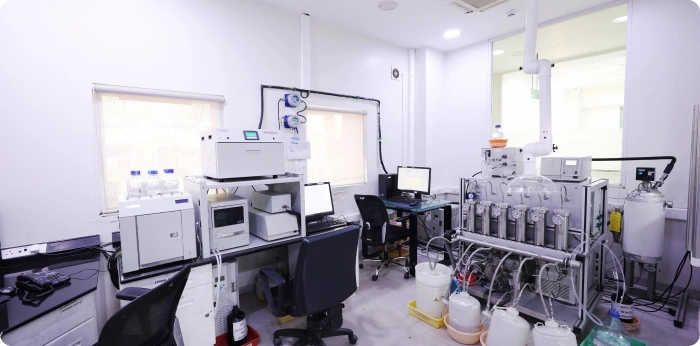
Chromatography is especially valuable in small-scale, fast-paced programs, where rapid access to purified material is essential for decision-making. In early discovery and development, teams often need milligram-to-gram quantities of compounds for bioassays. Under these conditions, chromatography can deliver results faster than developing a robust crystallization process, allowing programs to maintain momentum.
The technique also serves as a critical fallback when unexpected impurities arise. Structurally similar impurities can be extremely difficult, or even impossible, to remove via crystallization. This challenge is well recognized in areas such as payload-linker development, where chromatography is frequently the only effective purification option.
Certain compounds are inherently poor candidates for crystallization. Oily materials, lipids, and amorphous solids often resist forming well-defined crystal lattices, making chromatographic separation the more viable approach. Similarly, materials isolated from fermentation broth (which contain complex mixtures of closely related metabolites) are often best purified using chromatography rather than crystallization alone.
The success of a chromatographic purification depends heavily on choosing the right stationary phase. Normal phase chromatography, which relies on polar stationary phases such as silica, offers a cost-effective solution for many separations but is less suitable for highly hydrophobic or polar compounds.
In contrast, reverse phase chromatography supports a broader range of molecular properties and is often used when separations are particularly demanding. For molecules with chiral centers, chiral chromatography enables the separation of enantiomers and diastereomers.
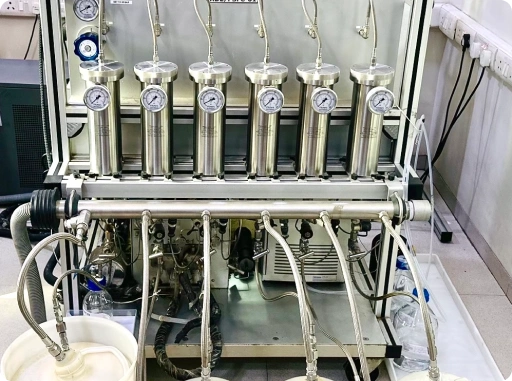
Effective chromatography requires more than equipment it depends on deep process understanding. Process development typically begins with laboratory familiarization, where reaction kinetics and impurity profiles are carefully evaluated. This foundation informs decisions aimed at improving purity and managing difficult impurities.
Mobile phase screening, often supported by thin-layer chromatography, helps identify solvent systems that maximize separation. From there, scalable elution strategies are developed to balance throughput, purity, and solvent consumption. Column loading studies play a central role, as optimal loading directly impacts efficiency and cost at scale.
Equally important is understanding compound stability during purification, including extended hold times and isolation. Degradation during elution or fraction handling can erode yields and introduce new impurities, making close coordination between manufacturing and analytical teams essential.
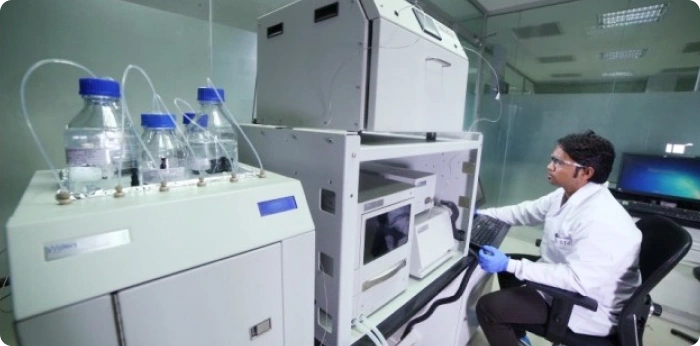
Piramal Pharma Solutions supports chromatographic development and manufacturing across multiple global sites, including Aurora (Canada), Riverview (USA), and Ahmedabad (India). These facilities collectively enable medium- and high-pressure chromatography, chiral separations, and preparative-scale HPLC, supporting applications from early development through kilogram-scale production.
Chromatography remains a vital, problem-solving tool in pharmaceutical purification. Whether accelerating early-stage programs, resolving stubborn impurities, or enabling the purification of challenging compounds, the technique offers flexibility that other methods cannot. When applied with experience and process insight, chromatography helps ensure that promising molecules continue moving toward patients.

Chromatography is often preferred in early-stage programs for removing closely related impurities or for compounds that are oily, amorphous, or otherwise unsuitable for crystallization.
Normal phase, reverse phase, and chiral chromatography are commonly used, depending on compound properties and separation requirements.
Yes, chromatography can be scaled for manufacturing using careful process development techniques, including mobile-phase optimization, column-loading studies, and stability assessments.