


Mar 30, 2026
.webp "Wet Milling for API Solubility Enhancement")
Low aqueous solubility remains one of the most persistent obstacles in modern drug development programs. Industry studies estimate that roughly 40% of approved drugs and up to 90% of pipeline candidates exhibit poor water solubility. For many compounds, improving solubility is essential to achieving adequate bioavailability and enabling successful clinical and commercial development.
One of the most effective ways to address this challenge is particle size reduction. By decreasing particle size, the surface area of an active pharmaceutical ingredient (API) increases, accelerating dissolution and improving bioavailability. While dry milling techniques have traditionally dominated this space, wet milling is increasingly being adopted as a complementary and, in some cases, preferred approach for API drug development.
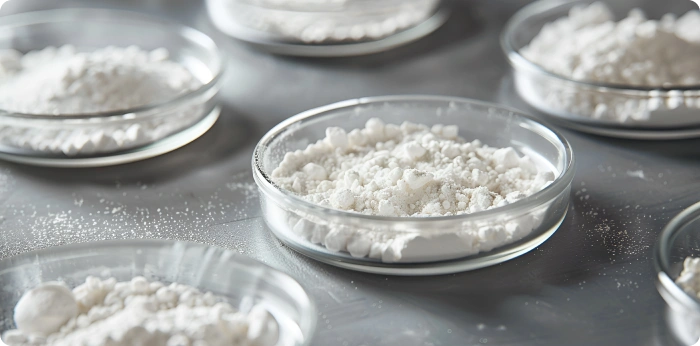
Wet milling involves dispersing an API in a liquid to form a slurry, which is then processed through a rotor–stator system to reduce particle size. After milling, the particles are isolated from the slurry and prepared for downstream use in solid dosage forms.
Because particle size reduction occurs in a wetted environment, wet milling can potentially be integrated with crystallization. This combination can eliminate additional isolation and drying steps, helping maintain cycle times while reducing waste and material losses.
Particle size does more than influence solubility it also affects flowability and manufacturability. Fine control of particle size distribution (PSD) can improve reproducibility during the production of oral solid dosage forms, helping reduce variability during scale-up.
Wet milling offers operational advantages compared with traditional dry milling, which requires isolating, drying, and handling powders. In contrast, wet milling enables crystallization, size reduction, and isolation to be completed within a single batch, delivering throughput and yield benefits.
The increasing prevalence of high potency APIs has further accelerated interest in wet milling. Because much of the processing is performed on wetted material, wet milling can reduce dust generation and help simplify containment strategies. This makes it particularly attractive for potent compounds where operator safety is a critical concern.
While wet milling may not achieve particle sizes as small as those produced by micronization, it is suitable for most solid oral drug substances. However, for applications requiring extremely fine particles, such as inhaled products, dry milling technologies may still be preferred.
For particle size reduction strategies to be effective, results achieved at smaller scales must reliably translate to larger batches. Wet milling outcomes can vary significantly when scale-up factors are poorly understood and uncontrolled.
Predictable scalability allows developers to use small-scale experiments to define processing parameters that deliver consistent PSD at kilo lab and commercial scale. Establishing this correlation early helps prevent downstream issues related to dissolution, bioavailability, or stability.
Piramal Pharma Solutions highlights scalability as a core consideration in its wet milling capabilities, using equivalent equipment across development and commercial facilities to support reproducible scale-up and process transfer.
Wet milling has emerged as a practical and scalable solution for addressing API solubility challenges. Its ability to improve dissolution, support safer handling of potent compounds, and integrate efficiently into manufacturing workflows makes it a valuable tool in modern API contract manufacturing. When applied with appropriate technical expertise, wet milling can help unlock the therapeutic potential of APIs that might otherwise fail due to poor solubility.

Wet milling is a particle size reduction process where an API is processed as a slurry, enabling controlled size reduction while improving safety and process efficiency.
By reducing particle size, wet milling increases API surface area, accelerating dissolution and improving bioavailability for poorly soluble drug substances.
Yes. Because the API remains wetted during processing, wet milling can reduce dust formation and support safer handling of high potency compounds.
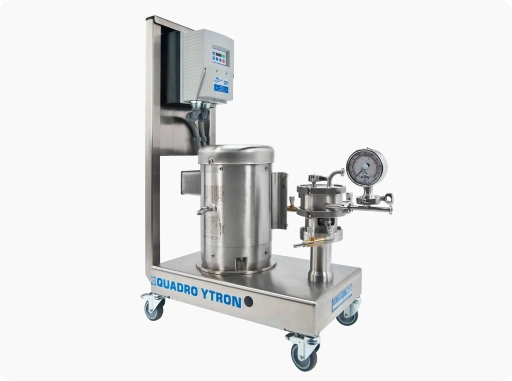
1)Quadro Ytron High Shear Mixer for Powder Induction and Dispersion
industrial high shear inline mixer machine with pressure gauge for pharmaceutical and food application
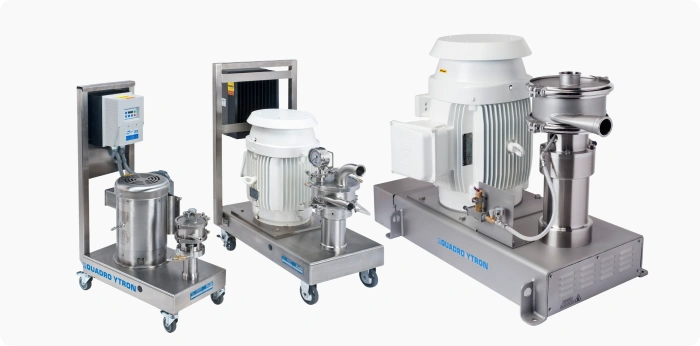
2) Quadro Ytron Industrial High Shear Mixer Systems for Powder Induction
industrial mixing equipment with large motor and inline homogenizer systems