


Jan 30, 2026
.webp "High-Throughput Experimentation in Drug Discovery Research")
Speed, efficiency, and smart use of limited materials are constant pressures in early drug development. High-throughput experimentation (HTE) has emerged as a powerful way for drug developers to address these challenges by rapidly exploring reaction conditions and generating actionable data that supports downstream scale-up.
By running many miniaturized reactions in parallel, HTE allows researchers to efficiently survey catalysts, reagents, solvents, stoichiometry, temperature, and other variables. This approach helps teams move beyond slow, iterative trial-and-error methods toward faster, data-driven decision-making.
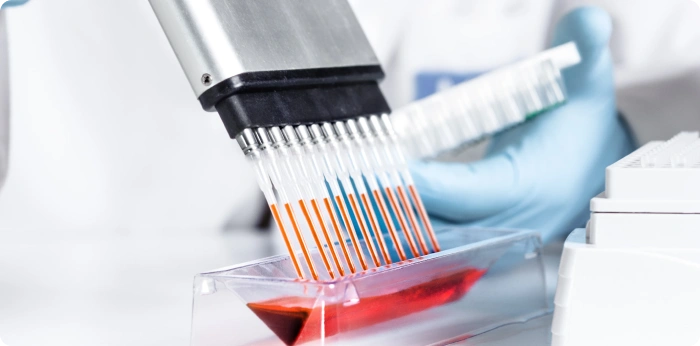
HTE involves running dozens of small-scale reactions simultaneously, typically using microwell plates and screening kits. Because each reaction requires only milligram-scale quantities of starting material, researchers can explore a broad design space while conserving precious compounds.
In drug discovery, HTE supports rapid route scouting and identification of viable synthetic pathways. As programs move into early development and process development, the same approach is used to improve robustness, reproducibility, yield, purity, safety, and scalability. The result is a stronger foundation for future manufacturing activities.
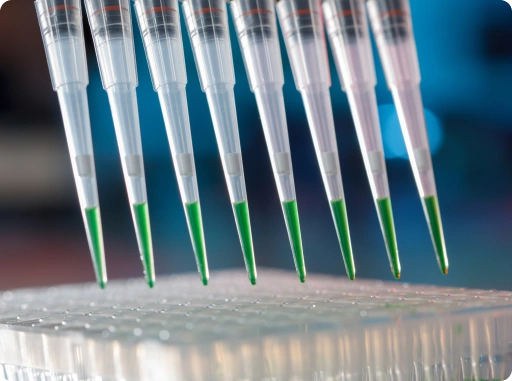
Traditional chemistry workflows often rely on sequential experimentation, where each experiment informs the next. While effective, this approach can be slow and resource intensive.
HTE enables teams to evaluate many conditions simultaneously, compressing timelines and generating richer datasets early. For example, with just 48mg of starting material, a chemist can run 24 distinct reactions at a 2mg scale. This efficient use of material reduces reagent and catalyst consumption while delivering insights that would otherwise take weeks or months to obtain.
By maximizing early understanding of reaction behavior, HTE accelerates drug development and helps teams make informed choices before committing to larger-scale work.
While the physical tools for HTE are widely available, successful application depends on deep scientific expertise. Designing meaningful experiments, interpreting complex datasets, and translating results into actionable next steps all require experienced chemists and robust analytical methods.
Within integrated drug development environments, HTE is most effective when discovery, development, and analytical teams work closely together. This integrated approach ensures that data generated at small scale can directly inform scalable, manufacturable processes.
Piramal Pharma Solutions has applied HTE across multiple discovery and early development programs:
These examples highlight how HTE accelerates R&D, conserves materials, and strengthens process understanding during discovery and early development. When embedded within integrated drug development and manufacturing models, HTE helps teams move faster with greater confidence, positioning programs for success as they progress toward the clinic.

High-throughput experimentation (HTE) is a method that runs many small-scale reactions in parallel to quickly identify optimal reaction conditions using minimal material.
HTE is valuable in early development because it accelerates decision-making by generating rich datasets early, improving reaction robustness, and reducing time spent on iterative experimentation.
By identifying critical reaction parameters early, HTE provides data that helps teams design processes that are more reproducible, efficient, and suitable for scale-up.