


Aug 06, 2026
.webp "How Spray Drying Is Advancing Peptide Manufacturing")
As peptide therapeutics continue to gain momentum across areas like oncology, endocrinology, and metabolic disease, manufacturers are looking for better ways to produce these sensitive molecules efficiently and at scale. One technology attracting increasing attention is spray drying.
Long used in pharmaceutical manufacturing, spray drying is proving highly valuable for peptide APIs because it combines gentle processing with controlled particle engineering. Compared to traditional drying methods, it can improve manufacturing efficiency while helping preserve product quality, making it a key tool for modern peptide development.
Spray drying is a manufacturing process that converts a liquid solution or suspension into a dry powder in a single continuous step. The liquid is atomized into fine droplets and introduced into a drying chamber, where the solvent rapidly evaporates. Within seconds, dry particles are collected for further processing.
Since the droplets cool as the solvent evaporates, the product only experiences brief thermal exposure. This makes spray drying well suited for heat-sensitive APIs, including many peptides.
One of spray drying's best-known applications is improving the performance of poorly soluble drugs. By creating amorphous solid dispersions (ASDs), the process can increase dissolution rates and boost bioavailability for compounds that would otherwise be difficult to formulate.
Beyond solubility enhancement, spray drying also offers important particle engineering advantages. Manufacturers can tailor particle size, density, and morphology to support different delivery formats, including oral dosage forms, inhalation therapies, injectables, and controlled-release formulations. The process can also encapsulate APIs within protective matrices, helping improve stability or provide taste masking where appropriate.
Unlike many traditional drying methods, spray drying is inherently continuous, making it easier to scale from development through commercial manufacturing.
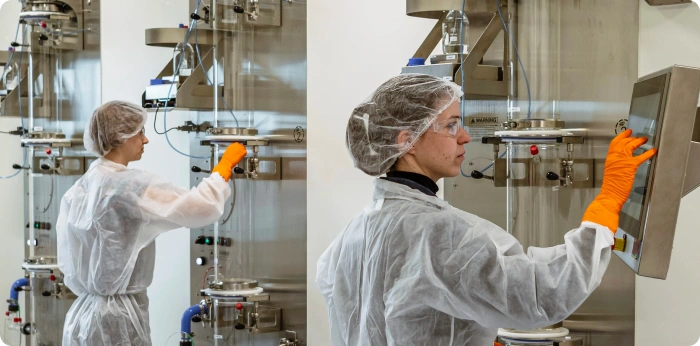
Peptides present unique manufacturing challenges. Many are sensitive to prolonged heat exposure, and producing a stable dry powder suitable for formulation has traditionally relied on lyophilization (freeze drying).
Spray drying offers an alternative approach under the right conditions. The rapid drying process helps maintain peptide integrity while producing a fine, uniform powder with controlled particle size. It can also reduce overall processing time compared with freeze drying, particularly for larger manufacturing campaigns.
For highly potent peptides, however, the manufacturing environment becomes just as important as the drying technology itself.
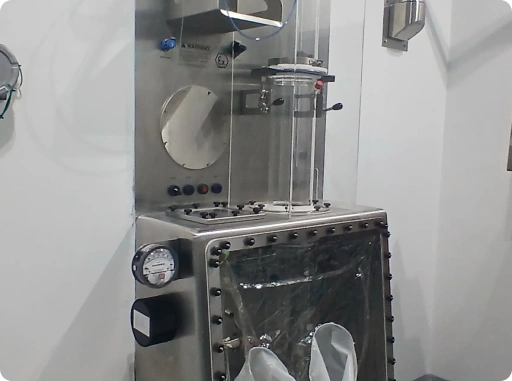
Handling potent peptide APIs demands specialized equipment and facility design to protect both operators and product quality.
At Piramal Pharma Solutions' Turbhe, India facility, a closed-loop spray drying system operates under an inert nitrogen atmosphere with explosion-proof (ATEX-rated) equipment for safe solvent handling. The system also incorporates essential containment technologies, such as flexible wall isolators, safe-change filtration, and enclosed product collection.
The surrounding facility has been purpose-built to support potent compounds, with dedicated cleanrooms, contained solution preparation areas, controlled pressure cascades, airlocks, and standalone utilities. Together, these engineering controls help maintain GMP operations while limiting operator exposure.
As peptide pipelines continue to grow, manufacturers are seeking technologies that can improve efficiency without compromising product quality. Spray drying addresses several important development challenges by combining gentle processing, scalable continuous manufacturing, and advanced particle engineering within a contained manufacturing environment.
For peptide developers, this creates greater flexibility as programs move from development through commercial production and supports the consistent manufacture of high quality APIs.

Spray drying is a process that converts liquid formulations into dry powders by rapidly evaporating solvent from atomized droplets. It is commonly used to improve bioavailability, engineer particle properties, and manufacture sensitive APIs.
Spray drying is used for peptide APIs because it provides a gentle drying method that minimizes thermal exposure while producing uniform powders suitable for downstream formulation.
Spray drying supports continuous manufacturing, particle engineering, bioavailability enhancement, and scalable production while helping maintain product quality for complex molecules.
The following Piramal facility supports spray drying and peptide manufacturing: