


Aug 07, 2026
.webp "api attributes pharmaceutical drug development")
Every successful medicine begins with a high quality active pharmaceutical ingredient (API). While formulation and finished dosage forms often receive considerable attention, the characteristics of the drug substance itself play a key role in determining how efficiently a product can be developed, manufactured, and ultimately delivered to patients.
Understanding and optimizing API attributes early in development helps reduce risk, improve manufacturability, and support consistent product quality throughout the product life cycle.
The terms drug substance and drug product are often used together, but they describe different stages of pharmaceutical development.
The active pharmaceutical ingredient (API), or drug substance, is the component responsible for producing the intended therapeutic effect. The drug product is the finished dosage form (i.e., a tablet, capsule, injectable, or suspension) that contains the API along with excipients designed to deliver the medicine safely and effectively.
Because the drug product depends on the characteristics of the API, understanding those properties early is essential.
Every API possesses physical and chemical characteristics that influence downstream development. Important attributes may include particle size, crystal form, purity, solubility, stability, moisture content, and flow properties.
These characteristics can affect manufacturability, formulation performance, dissolution, and long-term product stability. Identifying critical API attributes early enables development teams to design more robust and sustainable manufacturing processes.
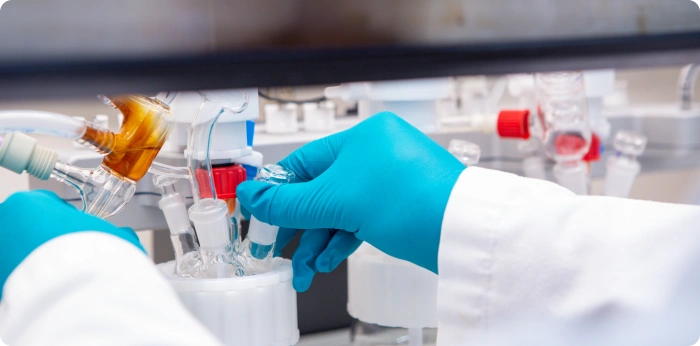
API manufacturing establishes the quality profile that downstream formulation processes depend upon. Variability introduced during manufacturing can affect processing efficiency and product performance.
Developing a well-controlled manufacturing process helps ensure that each batch consistently meets quality specifications while supporting efficient scale-up from laboratory development through commercial production.
Every active pharmaceutical ingredient (API) begins with chemical synthesis, or a series of carefully controlled reactions that create the desired drug substance. The way an API is synthesized directly affects critical quality attributes, such as purity, impurity levels, particle characteristics, and batch-to-batch consistency.
During development, scientists continually optimize the synthesis route to improve yields, reduce impurities, simplify manufacturing, and ensure scalability for commercial production. Optimizing the synthesis early helps ensure the API can be produced consistently, which provides a stronger foundation for successful formulation development and long-term product performance.
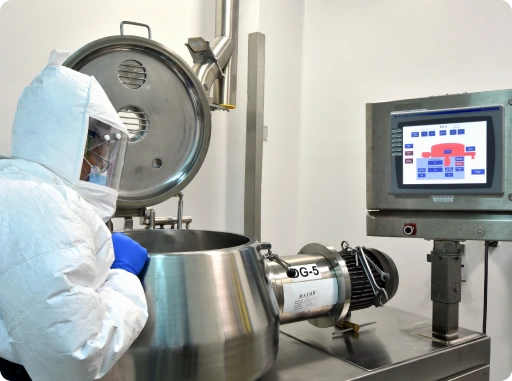
During formulation development, scientists evaluate how API properties interact with excipients and manufacturing processes to create a stable, effective dosage form.
For example, differences in particle size or crystal form can influence blending, compression, dissolution, and bioavailability. A thorough understanding of these relationships early helps minimize formulation challenges later in development.
Close collaboration between API and formulation teams often leads to more efficient product development and smoother technology transfer as projects progress.
API-related challenges can emerge at any stage of development. Common issues may include:
Addressing these challenges early reduces the probability of expensive redevelopment during clinical or commercial manufacturing.
Successful pharmaceutical development begins with proactive process understanding. Early analytical characterization, process optimization, impurity control, and collaboration between chemistry, analytical, and formulation teams all contribute to stronger development programs.
Integrated development strategies also allow manufacturing considerations to be incorporated much earlier, reducing downstream risk while improving overall efficiency.
Piramal Pharma Solutions leverages an integrated global network and extensive expertise spanning chemical synthesis, API development, analytical sciences, and formulation development to help sponsors build robust programs from the earliest stages through commercial manufacturing.

Developing both the API and drug product within an integrated organization like Piramal can simplify communication, reduce technology transfers, and improve continuity throughout development.
A partner with expertise across API manufacturing and formulation development is well positioned to support efficient scale-up while upholding quality and regulatory compliance standards.
The quality of the finished drug product begins with the quality of the API. By understanding and optimizing critical API attributes early, pharmaceutical companies can reduce development risk, improve manufacturability, and bring innovative products to patients in need.

A drug substance is the active pharmaceutical ingredient (API), while the drug product is the finished dosage form administered to patients.
API attributes are important during pharmaceutical development because they influence formulation performance, manufacturing efficiency, product stability, and overall product quality.
API manufacturing affects drug product development by helping ensure reliable formulation development, smoother scale-up, and reproducible product quality.
The following Piramal facilities support API development and manufacturing: