

Proteolysis-targeting chimera (PROTAC) molecules overcome a once-insurmountable drug development challenge. For years, researchers have known some proteins are implicated in human disease but have been unable to identify defined binding sites to unlock their therapeutic potential. PROTACs offer a way to target such “undruggable” proteins and improve patient outcomes, creating a need for teams with the synthesis and purification capabilities to support development of the molecules.
Proteins are the basic building blocks of the body and responsible for nearly every task in cellular life. As such, modulation of the expression of proteins affects what happens in the cell and by extension human health. The critical role of proteins in human health makes the molecules a hot spot for drug discovery.
Small molecules can modulate the activity of proteins to treat disease, if there is a suitable binding site. The active sites of some proteins are broad and shallow, making them difficult to bridge using a small molecule, while other proteins have smooth surfaces that lack viable binding sites. An estimated 85% of the proteome is considered undruggable because the proteins “lack well-defined binding pockets that can be functionally targeted with small molecules.”1
Whole classes of proteins known to play key roles in human disease, such as transcription factors, scaffolding proteins, and non-enzymatic proteins inside cells, lack the binding sites needed to unlock their therapeutic potential. These include members of the RAS family, MYC and TP53.2 The lack of molecules that can engage the proteins is preventing the development of drugs to address unmet medical needs.
Novel modalities such as RNA interference, gene editing and antisense oligonucleotides opened up new ways to treat disease, but they pose significant challenges in terms of bioavailability, stability, and delivery to the tissue of interest and have failed to address the need for a way to target undruggable proteins.
The solution to the problem may lie in the human body';s own system for degrading proteins (Fig. 1). In 2001, a team of scientists showed it is possible to artificially target a protein for degradation.3 Specifically, the paper demonstrated that rationally engineered molecules can use the endogenous protein-degradation machinery to degrade methionine aminopeptidase.

In doing so, the researchers revealed that it may be possible to use the internal ubiquitin-proteasome system to degrade disease-causing proteins. In recent years, biotechs have begun to validate the concept in clinical trials and large pharma companies have increased their investment in the space.4
Early efforts have largely focused on oncology, with multiple treatments for non-small cell lung cancer in development and PROTACs aimed at metastatic castration-resistant prostate cancer leading the industry pipeline. Yet, while oncology is serving as a proving ground for PROTACs, the longer-term plans of some companies in the area include the application of the modality to other indications such as immunology.5
The targeting of previously undruggable proteins is facilitated by bi-functional molecules that have three major components. Each PROTAC is made of: a ligand that binds to the protein of interest (POI); another ligand that binds to ubiquitin – protein (E3) ligases for ubiquitylation of target; and a linker connecting the two ligands.
Through the design of the PROTAC molecules, researchers can co-opt the activity of E3 ligases, enzymes that coordinate the addition of ubiquitin molecules to proteins to tag the proteins for degradation. The E3 enzyme enables the third stage of the three-step process that degrades intracellular proteins (Fig. 2).

Because PROTACs are not degraded, and can therefore repeatedly degrade their targets, the molecules are active in picomolar doses and the concerns about the poor pharmacokinetic profiles that can affect other modalities are less of an issue. However, PROTACs with such desirable drug-like properties have only moved into development in recent years as a result of work to overcome early problems.
In the nearly 20 year gap between the landmark protein degradation paper and early clinical validation of PROTACs, teams around the world worked to overcome a set of challenges that threatened to dull the impact of the novel modality.
Early PROTACs suffered from low cell permeability,micromolar potency and the sensitivity of the E3 recruiting phosphorylated degron toward endogenous phosphatases.First-generation candidates contained long-chain peptide linkers and, as such, cell permeability and cell viability were persistent problems.
The development of PEG linkers, as described in a 2008 paper, was a breakthrough in efforts to overcome the limitations of first-generation PROTACs.6 Using PEG linkers,researchers were able to have one end of the molecule act as a ligand that selectively binds to the androgen receptors,and the other end serve as a ligand for an E3 ligase. The design improved cell penetration
Building on the 2008 paper, chemists created a seriesof PROTACs based on different E3 ligases. The discovery that immunomodulatory drugs, including approved cancer medicines such as thalidomide, lenalidomide and pomalidomide, could act as ligands for the E3 ligase CRBN led to the development of a large number of PROTACs based on the enzyme. Those PROTACs degrade proteins including BRD4, CDK9, Sirt2, KRAS G12C, AKT, HDAC6 and CDK6.
Other researchers have used: VHL-based PROTACs to degrade ERRα, RIPK2, HaloTag7 fusion proteins, BRD4,Smad3 and RTK; RNF114-based PROTACs to degrade BRD4 and BCR-ABL; and IAP-based PROTACs to degrade RIPK2, CDK4/6 and Bcl-XL. The range of E3 ligases used, and the breadth of proteins degraded, points to the potential of the emerging drug modality.
Having resolved the initial barriers to the use of PROTACs,researchers have begun to explore ways to further improve the modality. Multiple reports show optimization of the linker length and stabilization of ternary complexes can expand the selectivity of PROTACs for their protein targets beyond that of their parent ligands.
Evidence of improved selectivity and the efficacy of rationally designed PROTAC molecules has led many biotechs and leading pharma companies to start development programs. The success of the programs will rest on access to expertise in synthetic route designing.
Such expertise gives programs access to the diverse scaffolds, such as orthogonal protection strategies, mono functionalization, click chemistry, regio-selective approaches and more, that are needed to create PROTAC molecules. PROTAC programs also benefit from streamlined purification procedures and parallel synthetic strategies that decrease synthetic timelines and enable quick material generation to expedite structure-activity relationship studies.
Piramal Pharma Solutions, a global service provider that has synthesized many E3 ligases ligands (CRBN, VHL, IAP, and MDM) in multi-gram quantities, is well versed in the synthesis and purification techniques needed to
accelerate PROTAC R&D programs. The company is using the capabilities to support PROTAC target synthesis programs at multiple pharma companies.
Work is underway to expand the service offering, with Piramal Pharma Solutions investing to extend its in-vitro biology services. The investment covers E3 ligase activity, ternary complex formation and target ubiquitination and degradation. Piramal Pharma Solutions will use various assay technology platforms such as ELISA, tandem ubiquitin binding entities, TR-FRET, Nano-BRET, ALPHALisa/ALPHAScreen, fluorescence polarization and NanoGLo Hi-BiT.7

Through the investment, Piramal Pharma Solutions is cementing its status as a leading partner for PROTAC development. Biopharma companies that work with us will access experience and an expanding range of leading technologies, positioning them to help patients by developing PROTACs that drug the undruggable and address major unmet medical needs.
References
1. Spradlin, J. N., Zhang, E. & Nomura, D. K. Reimagining Druggability Using Chemoproteomic Platforms. Acc. Chem. Res. 54, 1801–1813 (2021).
2. Pathmanathan, S., Grozavu, I., Lyakisheva, A. & Stagljar, I. Drugging the undruggable proteins in cancer: A systems biology approach. Curr. Opin. Chem. Biol. 66, 102079 (2022).
3. Sakamoto, K. M. et al. Protacs: chimeric molecules that target proteins to the Skp1 Cullin-F box complex for ubiquitination and degradation. Proc. Natl. Acad. Sci. U.S.A. 98, (2001).
4. PROTACs VS. Traditional small molecule inhibitors. https://www.biochempeg.com/article/233.html.
5. R&D Meeting - Targeted Protein Degradation - https://www.irwebcasting com/ 20221209/3/579a0b9058/mov/main/index.html.
6. Schneekloth, A. R., Pucheault, M., Tae, H. S. & Crews, C. M. Targeted intracellular protein degradation induced by a small molecule: En route to chemical proteomics.Bioorg. Med. Chem. Lett. 18, 5904–5908 (2008).
7. Liu X, Zhang X, Lv D, Yuan Y, Zheng G and Zhou D. Assays and technologies for developing proteolysis targeting chimera degraders. Future Med Chem. 12, 1155-1179 (2020).
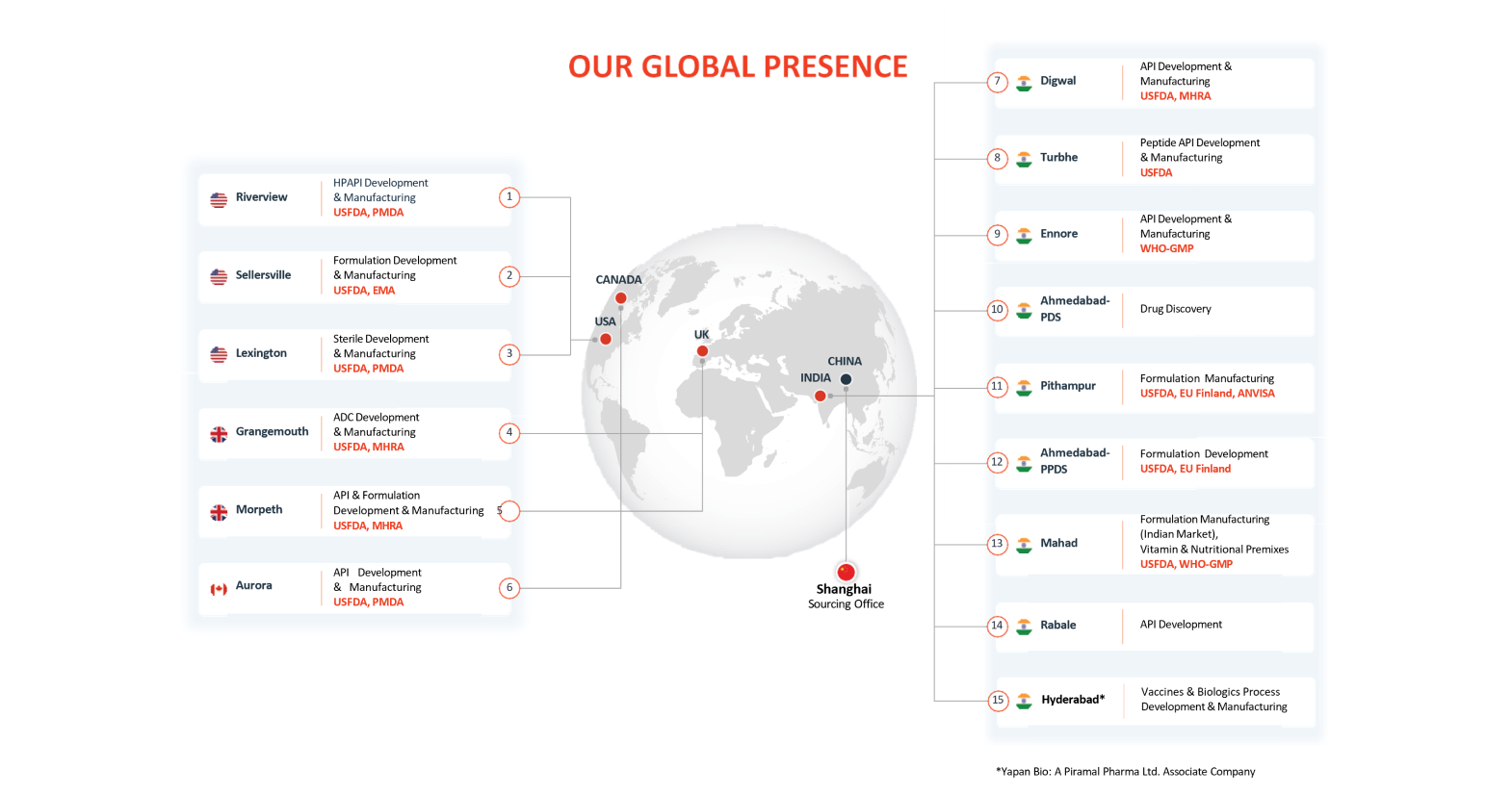
Piramal Pharma Solutions (PPS) is a Contract Development and Manufacturing Organization (CDMO) offering end-to-end development and manufacturing solutions across the drug life cycle. We serve our customers through a globally integrated network of facilities in North America, Europe, and Asia. This enables us to offer a comprehensive range of services including drug discovery solutions, process and pharmaceutical development services, clinical trial supplies, commercial supply of APIs, and finished dosage forms. We also offer specialized services such as the development and manufacture of highly potent APIs, antibody-drug conjugations, sterile fill/finish, peptide products and services, and potent solid oral drug products. PPS also offers development and manufacturing services for biologics including vaccines and gene therapies, made possible through Piramal Pharma Limited's associate company, Yapan Bio Private Limited.