

-1.png "Cleanroom Pharmaceutical Research and Development Laboratory")
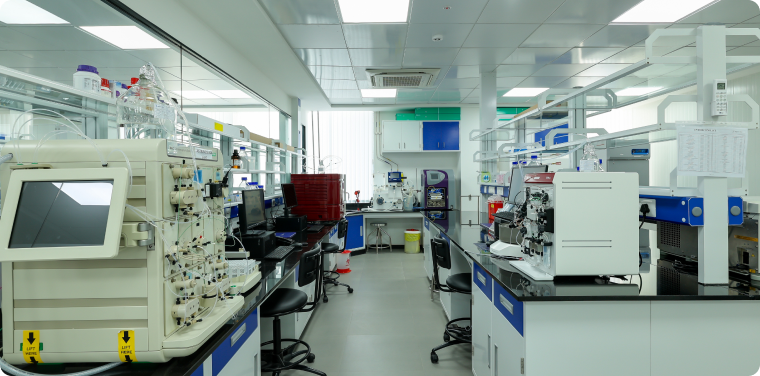
-1.png "High-Performance Liquid Chromatography (HPLC) System for Chemical Analysis")
-3.png "Green Fluorescent Protein (GFP) Expression Under Microscope")
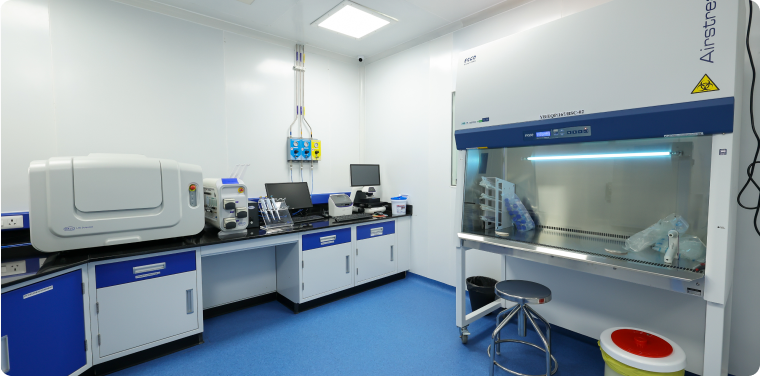
-2.png "Data Analysis Workstations in Biotech Laboratory")
A deno-associated virus (AAV) vectors have been identified as the safest and most effective gene delivery vehicles in vitro in cultured cells and in vivo in animal models. AAV is a small, non-enveloped and single standard DNA genomic virus that offers a promising new approach to vaccine and gene therapy product development owing to its simple transgenic coding manipulation, efficient transfection of various mammalian cell lines and comprehensive immune response over the target antigens.
HEK293 cell lines are extensively used in the production of AAVs due to the presence of the adenoviral E1A/B genes, which provide helper functions during viral vector replication. Production of recombinant AAV vectors (rAAV) is commonly accomplished by transfection of HEK293 cells with a rAAV viral vector and a packaging construct in the presence of adenoviruses (AdV). After identification of AdV regions essential for AAV vector packaging, a helper virus-free strategy is established by a constructed helper plasmid acting as supplementary viruses. Hence, a helper-free system is a triple transfection protocol consisting of three plasmids, and this system is widely used in therapeutic research and drug development. AAVs are highly flexible to scalable manufacturing processes such as the use of stirred tank bioreactors, high-volume filtration approaches, and chromatographic purification strategies.
AAVs: Additional Attractions
• Non-pathogenicity
• Very low inflammatory potential
• Long-lasting gene expression
• Availability of viral serotypes with various tissue tropisms
• Restricted to generation of neutralizing antibodies, while they induce no clearly defined cytotoxic response
• Ability to infect quiescent cells present their dominance
• Strong and long-lasting Ab response
AAV2 is one of the most promising serotypes: highly stable, well characterized and sequenced for in vivo viral based gene therapy applications. In addition, the following characteristic features made AAVs unique in the field of gene therapy and clinical applications.
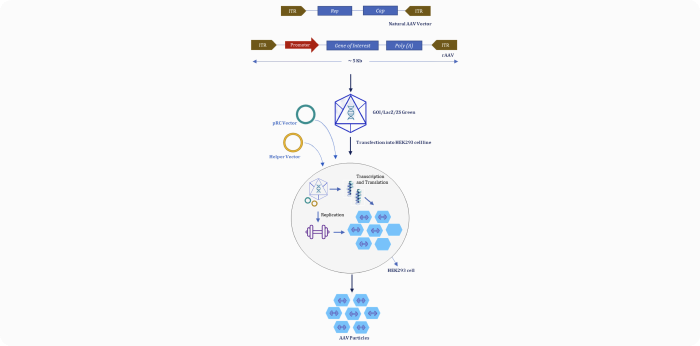
In this work, preparation of serotype AAV2 particles is accomplished to deliver the reporter gene LacZ and green fluorescence ZSGreen gene in HEK293 cells (AAVpro® Helper Free System, Takara). Figure 1 presents the outline of the triple-transfection approach for rAAV production.
The HEK293-based transient triple-transfection process has been carried out with pRC vector, pHelper vector and LacZ/ZSGreen vector. The AAV Helper Free System is used to prepare the high titer AAV2 particles without a helper virus in a 6-well plate. This triple-transfection strategy removes the need for an AdV by instituting key genes in a DNA plasmid, extended by two other plasmids. The vectors are used to prepare AAV2 particles that can deliver a LacZ/ ZSGreen along with the transgene expression cassettes. The three plasmids were transfected into the HEK293 production cell line, which generates AAV2 particles encompassing the transgene of interest. Figure 2 illustrates the protocol followed to produce rAAV particles from HEK293 cells.
AAV2-LacZ particles can be used as a positive control for in vitro and in vivo gene transfer. ZSGreen is a green fluorescent protein and has been engineered for higher expression in HEK293 cells. ZSGreen transfection efficiency is detected by fluorescence microscopy and flow cytometry analysis.
Procedure for the production of rAAV particles in HEK293 cell line
Cloning of Gene of Interest (GOI)
🡓
Recombinant AAV preparation
🡓
Culturing of HEK293 cells
🡓
Triple-transfection of HEK293 cells
🡓
Culture medium exchange
🡓
AAV producing cells
🡓
Extract virus particles
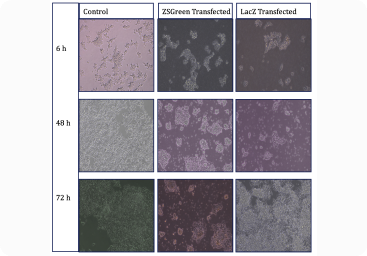
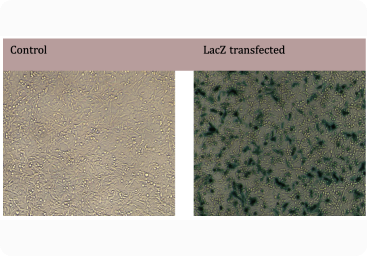
The HEK293 cells were transfected with rAAV with LacZ and ZSGreen genes. Figure 3 displays transmission microscopic images of transfected 293 cells with LacZ and ZSGreen genes along with control (unaffected). The results state that as the time progresses the transfected cells replicated proportionately and reached a maximum after 72 h of transfection.
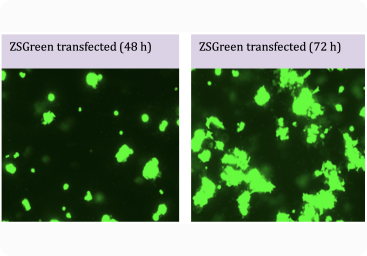
The HEK293 cells transfected with ZSGreen were found to be induced with green fluorescent protein. The Green fluorescent protein levels of transfected 293 cells were recorded high after 72 h of incubation.
The gene delivery to host was analyzed by evaluating expression of LacZ reporter gene through infecting HT1080 cells using extracted AAV2-LacZ viral particles. Staining was performed using the β-Galactosidase (β-gal) Staining Kit (Takara) and maximum β-gal was expressed in 48 h of incubation as exhibited.
The AAV2 virus titer was measured by the vector genome assay (RT-PCR) using the viral ITR domain as a target. The threshold cycle (Ct) values for each reaction were calculated and six dilutions of stock virus were used to generate the standard curve. The results suggest that the Ct values of AAV2 virus are in accordance with the regression line and the AAV2-LacZ virus titer is found to achieve 1.82
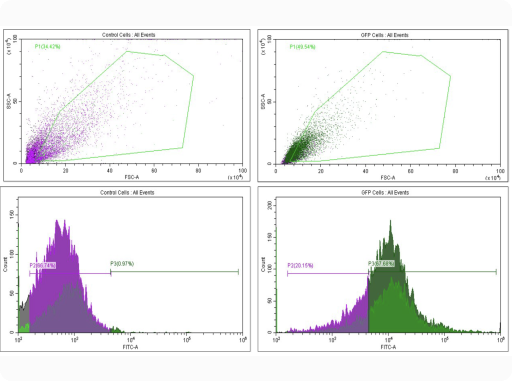
X 1010 copies/mL. The transfection efficiency was analyzed by measuring the expression of the gene of interest (ZSGreen) from AAV2 vector using Flow cytometry. Figure 6 demonstrates the density (gate) plots from cytometry, which shows the correlation between a control and transfected (ZSGreen) cells. The light scatter (SS vs FS) defines two distinct populations known as control (un-affected) and ZSGreen transfected cells with the cell count of 1.0 X 10⁶.
A region has been drawn around the transfected cell cluster in the light scatter cytogram (color gating). The results suggest that maximum amount (> 50%) of cells fell in the transfected cell gate (purple color), which confirms the expression of gene of interest.
In the current work, the recombinant AAV2 particles were successfully produced with the deliverables of reporter gene LacZ and green fluorescence ZSGreen genes in HEK293 cells. The maximum transfection efficiency of AAV2 is achieved at 72 h while AAV efficiently transduce proliferating at 48 h. The LacZ gene can be replaced with a transgene, which would be used for production of gene therapy products.
Piramal Pharma Solutions (PPS) is a Contract Development and Manufacturing Organization (CDMO) offering end-to-end development and manufacturing solutions across the drug life cycle. We serve our customers through a globally integrated network of facilities in North America, Europe, and Asia. This enables us to offer a comprehensive range of services including drug discovery solutions, process and pharmaceutical development services, clinical trial supplies, commercial supply of APIs, and finished dosage forms. We also offer specialized services such as the development and manufacture of highly potent APIs, antibody-drug conjugations, sterile fill/finish, peptide products and services, and potent solid oral drug products. PPS also offers development and manufacturing services for biologics including vaccines and gene therapies, made possible through Piramal Pharma Limited's associate company, Yapan Bio Private Limited.