


Solid form screening is an integral part of many preformulation research and development activities at various companies, including screening of polymorphs, salts, cocrystals, amorphous and amorphous dispersions. It is well documented that the molecular packing of both the active substance and excipients in the solid state influences the pharmaceutical efficacy of drugs1 . On the one hand, the diversity of solid forms increases and on the other, it is used as a key element in product design, including single-component and multi-component systems. This highlights the importance of very carefully characterizing the composition of the solid form of the drug.
At the same time, the rapid development of solid-state analytical instruments, data analysis, computational methods and process analysis techniques made it possible to more accurately characterize the solid substance as part of complex dosage forms. An essential part of risk-based drug development is an early discovery of the ideal solid form based on clinical significance. All these developments suggest that understanding the diversity of solid forms and choosing the most informative and useful solid-state analytical methods play an important role in the overall drug development process. This paper critically addresses these challenges and highlights the elements that are important for viable and meaningful analytical characterization.
Screening methods for polymorphs, salts, cocrystals and amorphous dispersions use several traditional solvent and solvent-based methods. The solid state of a pharmaceutical material affects all aspects of its formulation, from solubility and thermodynamic stability to tablet strength and flowability. Because of this fundamental relationship, solid-state characterization is key in providing the information needed to reduce potential future manufacturing or formulation problems, critically reducing drug costs and time. Choosing the right analytical instrument is a challenge in solid-state analysis, as the choice depends on the specific solid-state application. Different method sensitivity, sampling and data analysis can help determine the specific analysis of required applications.
In general, one should not rely on a single analytical method. A combination of analytical methods can help determine a candidate's character. Different analytical techniques are sensitive to different lengths and order scales, and thus should be evaluated appropriately. One such challenge that highlights this complexity is the manufacturing of an amorphous material by milling. Mah et al.2 used dry ball milling to transform crystalline glibenclamide into an amorphous form. The powder was analyzed after different grinding times by three techniques: powder X-ray diffraction, XRPD (as the disappearance of diffraction peaks), Raman spectroscopy (spectral changes detected by principal component analysis {PCA}) and DSC (expressed as a change in the initial temperature of crystallization). The samples were first "X-ray amorphous" (after 30 min milling), then "Raman amorphous" (after 60 min), and finally "DSC amorphous" (after 180 min). These differences in sensitivity may be due to the different phenomena studied by these methods.
While powder X-ray diffraction is sensitive to lattice defects, Raman spectroscopy is sensitive to shorterrange intermolecular ordering. On the other hand, DSC-induced crystallization may be sensitive to the presence of residual crystallites during milling, which may be less than the sensitivity of XRPD and Raman and/or infrared spectroscopy. It is clear from this example that one analysis method is not necessarily reliable. However, some published literature indicates that DSC analysis was best correlated with both storage stability and dissolution behavior and therefore the most important2 .
Another determining factor in the choice of technique is sampling: different analytical methods have different sample geometries, preparation, and spatially separated analysis capabilities. Some commonly used analytical methods are strongly surface biased (e.g., Fourier transform infrared spectroscopy (FTIR) with attenuated total reflectance (ATR) sample accessory), while others have no surface biases (e.g., DSC).
Collecting and organizing the data from potentially numerous sources so it can be explored in meaningful ways and then structured into useful information is the best way to enable decision-making and aid in troubleshooting production issues that may arise. Rigor in understanding the compound';s physicochemistry will help in the formulation, manufacturing, shipping, handling, and ultimately dispensing of the drug to patients with greater assurance and longterm success.
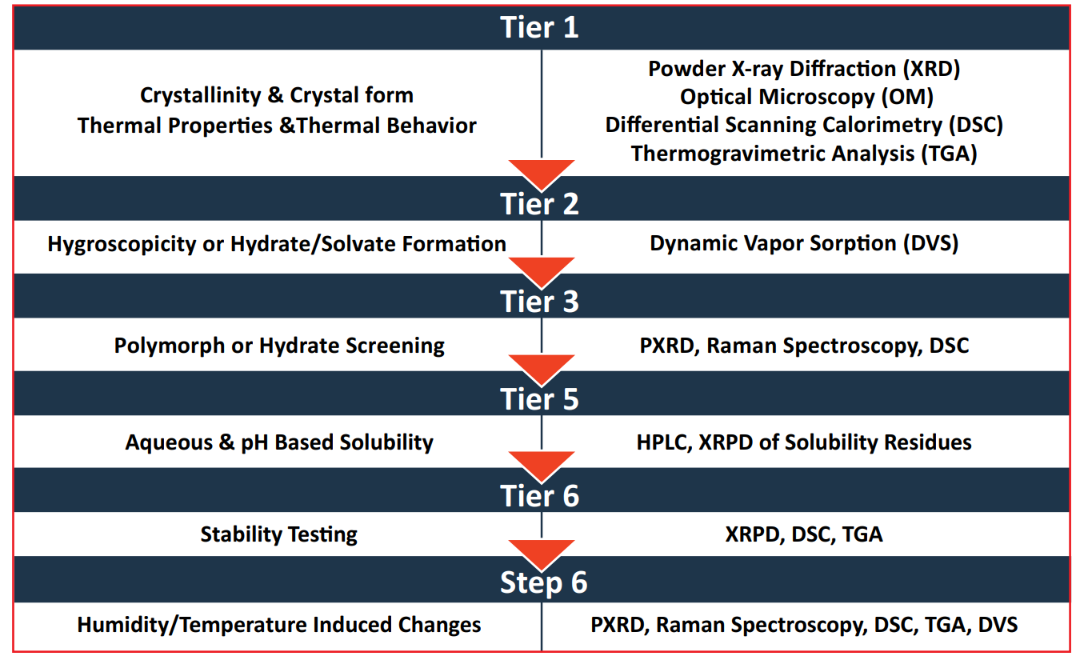
Initially, in the industrial development process, only small amounts of the target API remain available, limiting the capability to screen an API. The progression from an initial target molecule to a desired form, be it a salt or co-crystal, is a long process. To limit experimental time screening all possible forms of an API, typically a multi-tiered systematic system should be used, highlighted in Figure 1. In this, starting material or samples crystallized from a small selection of solvents should be analyzed for polymorphic form, crystallinity and habit usually using Powder XRD and optical microscopy; this provides initial information as to the crystallographic characteristics of the material.
Following acceptable results from Tier 1 analysis, further batches of the API should be tested for thermal behavior using DSC to characterize any undesirable phase transitions that may occur in the solid state.
This also provides useful information regarding the possible future appearance of any meta-stable phases during the stability test. Also, at that stage, the formation of some hydrate and/or solvate structures can be characterized by DVS (Tier 2), and the thermal solvation of some such species can be monitored by DSC/TGA. Once candidate APIs have reached tiers 3 and 4, a more rigorous analytical approach requires large-scale batch production. This includes full polymorph and solvate/hydrate screening and solubility testing of each form.
The typical industrial work flow of polymorph screening study is described in Figure 2. This illustrates the tendency of the sample to phase change or chemically degrade. Lastly, the final API candidate and the excipients should be tested for compatibility and their behavior at stability conditions3 . The techniques discussed above should be again used for re-analysis of humidity/ temperature-induced changes in the system.
Industry screening of potential API candidates aims to reduce some of the risks related to stability and polymorphism issues. The purpose of the screening process is to improve the understanding of possible phase changes, detect all possible dissolved polymorphs, and assess possible hydrate or solvate formation and to override unwanted API functions associated with their appearance (e.g. poor solubility/dissolution profile, chemical/environmental stability and mechanical properties such as powder compaction and flow).
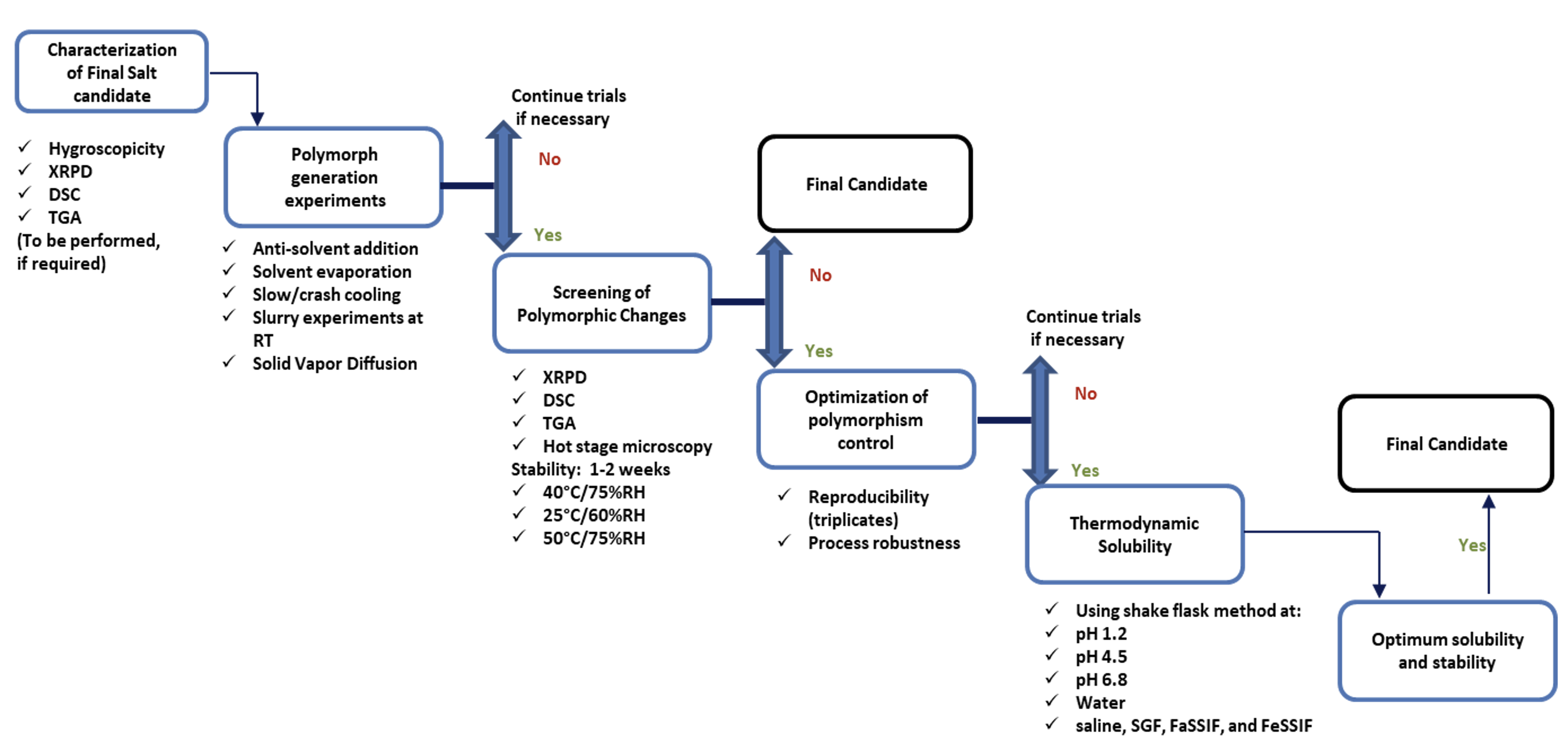
Traditional methods include solvent-based and non-solvent-based approaches, which help in generation of polymorphs for their screening. When stable forms are desired, thermodynamic conditions can be achieved by using slower crystallization methods. Formation of metastable forms requires kinetic conditions that involve faster time scales.
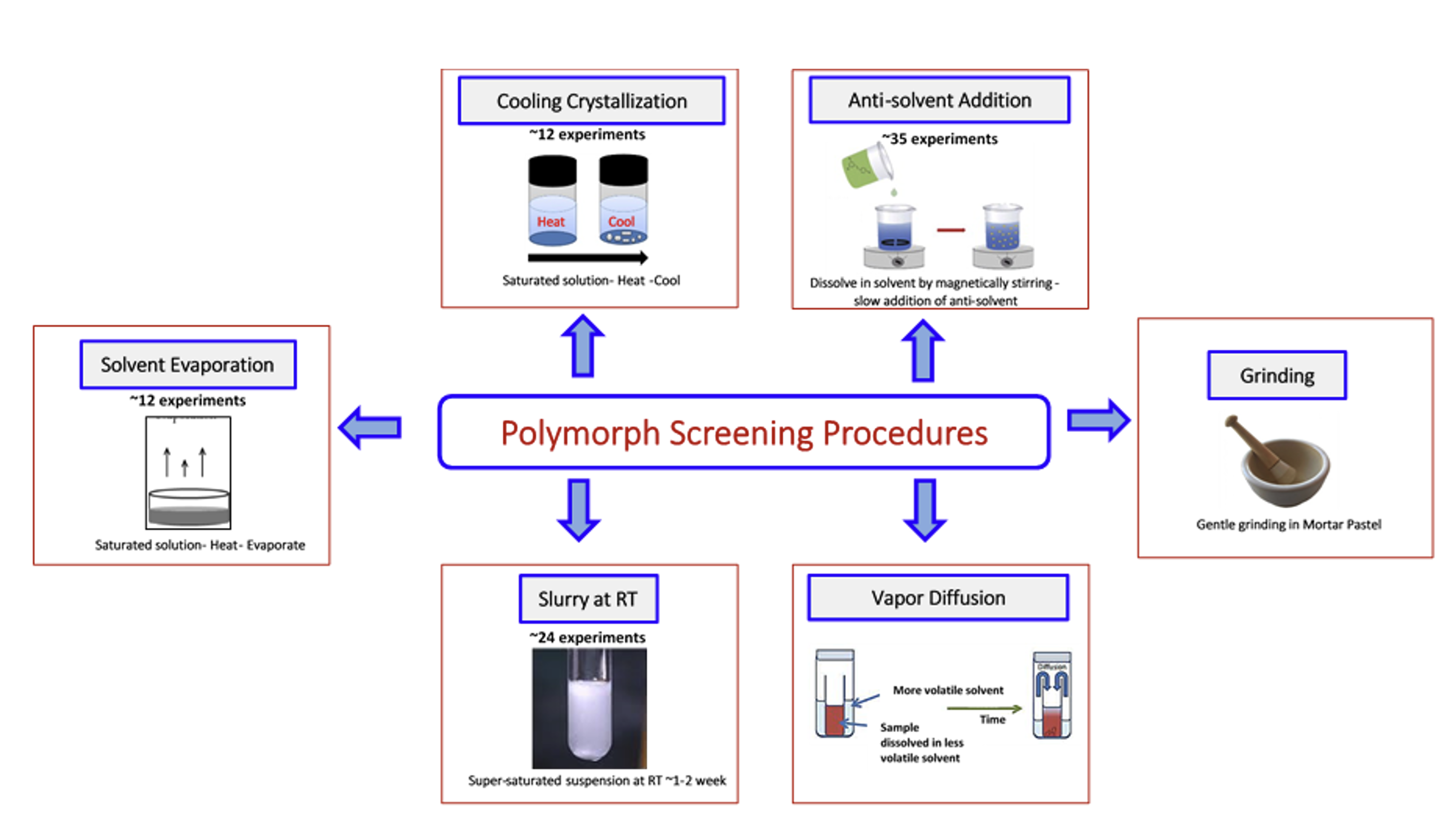
Figure 3 illustrates several crystallization methods for polymorphism generation due to the variety of solvents and conditions used. They also provide early information on the large-scale crystallization of the API. The use of solvents or solvent mixtures includes solvent cooling, evaporation, solvent addition and vapor diffusion techniques. Variations in these methods can include changes in solvent, solvent mixture, anti-solvent, temperature, cooling rate, concentration, addition rate, and mixing order. A large number of parameters can be changed for intractable screening experiments. Both manual crystallization methods and automated approaches are used in polymorphism screening. The ideal screen is a combination of solvent, non-solvent, manual and automated methods.
The classic techniques are often sufficient to find many solid forms for many different systems. However, there are always cases where a different approach may be necessary in a complex situation or to expand the crystallization space of the screen. One goal of most polymorph screens is to identify a thermodynamically stable form. Finding this form in the early development phase allows us to assess its characteristics and development.
Figure 4 shows the time frames for the methods generally used in polymorph screening. A stable form screen typically employs slow crystallization conditions under thermodynamic rather than kinetic conditions. Experiments can include slurrying, slow evaporation, slow cooling, slow antisolvent addition, or a combination of these methods. Solvent-mediated polymorphic transformations using slurries is a common screening method to produce the most stable form at ambient temperature, and a stable form screen using this approach has been reported. However, the methods dealing with kinetic conditions (e.g. spray drying, grinding and cooling crystallization) favor metastable form generation. Many crystallization methods are useful in potential when preparing a development plan. Figure 4 illustrates a pathway by which experiments can be designed to examine various polymorphic transitions.
Most companies want to develop the most stable form possible to minimize process-induced changes during storage and drug preparation. As observed with ritonavir, the most stable form also has lower solubility than the metastable form4 , so early detections can help avoid problems later in development. Early developmental screens focusing on the most stable form are increasingly common for new chemical entities (NCEs). A small stability screen at the pre-formulation stage can provide important information to help guide API crystallization and early formulation process development. More advanced screenings can be performed to find additional forms if a stable form cannot be easily developed or if the compound evolves further.

Characterization of solids is a key aspect of drug development, since solid drugs are very important to the pharmaceutical industry. Solidstate characterization of drugs determines physical properties such as particle size, polymorph, and morphology of solid dosage forms. Therefore, it is important to perform the solid state analysis right from drug development to manufacturing for the development of safe and effective pharmaceutical products. The most critical aspect in the development of pharmaceutical compounds is the choice of the optimal solid form because they can exist in more than one form and therefore finding the most thermodynamic stable form is of great challenge. Thus, a single analytical method should not be solely relied upon instead one should use a combination of analytical techniques to evaluate solid-state physicochemical properties. Importantly, these physical properties can majorly affect properties such as drug formulation efficiency, processability, stability, and appearance.
References
-(22).jpg)
-(23).jpg)
Piramal Pharma Solutions (PPS) is a Contract Development and Manufacturing Organization (CDMO) offering end-to-end development and manufacturing solutions across the drug life cycle. We serve our customers through a globally integrated network of facilities in North America, Europe, and Asia. This enables us to offer a comprehensive range of services including drug discovery solutions, process and pharmaceutical development services, clinical trial supplies, commercial supply of APIs, and finished dosage forms. We also offer specialized services such as the development and manufacture of highly potent APIs, antibody-drug conjugations, sterile fill/finish, peptide products and services, and potent solid oral drug products. PPS also offers development and manufacturing services for biologics including vaccines and gene therapies, made possible through Piramal Pharma Limited's associate company, Yapan Bio Private Limited.