

Maintaining a customer-centric culture requires constant vigilance. The expectations of customers are always evolving, sometimes rapidly, in response to developments and market fluctuations. To be customer centric, pharmaceutical service providers must be attuned to changes in expectations and prepared to pivot quickly in response to them.
At Piramal Pharma Solutions, customer centricity is an organizational mindset that places customers, rather than product or sales, at the center of the business. In this approach, the customer experience is more than an afterthought or even the result of the service a partner receives; it is intentionally and strategically designed to be what differentiates the company from other service providers
Piramal Pharma Solutions (PPS) established a customer centricity function in 2014, making it one of the first companies in the pharmaceutical industry to have a dedicated team. The establishment of the function marked a milestone in the company';s evolution from a business centered around products to one focused squarely on its customers.
That shift in emphasis had far-reaching consequences. Virtually every touchpoint between PPS and potential and current clients contributes to the perceptions, satisfaction and loyalty of customers. For PPS, getting those touchpoints right can reduce churn and lead to profitability
Recognition of the importance of customer centricity led PPS to put the “Pulse of the Customer” at the heart of its mission. The outlook applies to every interaction the customer has with PPS throughout their lifecycle, whether they are in-person, on calls or via emails.
Delivering the right experience at every touchpoint requires coordination across groups including marketing, product development, project management, business development and operations. The end goal is to deliver a product or service that satisfies a customer need associated with a short or long-term project, but hundreds of small, daily, routine actions across the business contribute to the successful delivery of that objective.
-(19).jpg "Becoming Customer Centric")
A structured, methodical approach to customer centricity is essential to the success of the initiative at multinational companies such as PPS. Customer centricity requires the whole business to act consistently in a way that best serves the needs of clients. A concerted effort is needed to achieve such consistency across a global organization.
Leadership is vital to the success of the wholesale transformation of outlook and operations needed to become a customer-centric organization. Strong leaders who exhibit customer-centric role-model behaviors set the example for the people who serve customers directly and build great experiences. PPS empowers customer-facing teams to take complete ownership of the process, for example by having the customer centricity team report directly to the Chief Commercial Officer. The structure ensures issues are rapidly escalated to the senior leadership team to support swift resolutions.
By working to improve every touchpoint, PPS seeks to deliver experiences that meet or exceed customer expectations and lead to fruitful long-term relationships. The first major milestone on that journey is very important. In each successful relationship, there is a moment when the customer first realizes the added value a partner is bringing, a moment PPS calls the “first wow.” PPS wants all of its relationships to deliver an early “wow” and continue to exceed customer expectations.
-(20).jpg "Improving Every Touchpoint")
Yet, focusing only on the positive experiences undermines efforts to improve customer centricity. The process must also involve analyzing the full range of “unvarnished” realities of a customer's prior experiences and the expectations they have set. By monitoring and probing neutral and negative expectations, PPS seeks to improve the customer experience and change expectations.
PPS collects information across four touchpoints: Voice of Customer (VOC), Voice of Process (VOP), Voice of Business (VOB) and Voice of Employee (VOE). VOC, for example, is assessed by sending surveys to customers to gather feedback. The surveys enable the monitoring of key metrics such as Net Promoter Score (NPS) and Customer Effort Score (CES).
Using NPS metrics, PPS has established a robust feedback mechanism that assists it in assessing customer loyalty. The CES acts as an indicator of the customer's effort to push matters for resolution.
The VOC process also covers the qualitative Call Quality Report (CQR). The customer centricity team sends out a CQR whenever an interaction on the phone falls short of the basics of conference call etiquette, such as being on time and addressing the concerns of the customer. By sharing CQRs with the site leadership and everyone who was on the call, the customer centricity team strives to raise awareness of the basic etiquette and highlight areas for improvement.
PPS collects complementary information across the other three touchpoints. VOP covers all of the steps on the customer journey up to the final shipment of the project. Upon request, PPS will perform on-site Customer Experience Auditing and look into all of the necessary arrangements to be made.
VOB is an internal process that looks into text analysis, know your customer, integrated projects and sentiment analysis. Finally, VOE ensures PPS has the internal alignment needed to position itself to meet the needs of all of its customers. The VOE touchpoint is supported by annual surveys of cross-functional teams such as IT that ask internal customers to rate PPS';s performance against key metrics including turnaround time, people, delivery timelines and responsiveness.
Analyses of the results of the internal partner satisfaction surveys are shared with the head of the department of the relevant function. The department head uses the feedback to create action plans focused on areas of improvement and shares the strategy with the senior leadership team. The VOE touchpoint also involves internal workshops for employee-facing teams on topics such as electronic etiquette, business communication, customer focus and executive presence.
The focus on gathering data across the four touchpoints reflects a belief that it is critical to be able to measure customer perception. The information-gathering activities extend to the surveying of customers to better understand their experiences of working with PPS. Using the responses, the customer centricity team identifies insights and creates a comprehensive presentation for the senior leadership team.

The survey design is based on the Lean Six Sigma model, where the questions are bucketed into six parameters: delivery, service, quality, value, innovation and people. PPS has designed the survey to gather as much feedback as possible and thereby generate a Customer Satisfaction Index (CSI) score that accurately reflects the experience of the customer
That process only works if customers are willing to provide honest feedback. Recognizing that some customers may be reticent to speak out about negative experiences, the customer centricity team tries to go the extra mile to understand their problems and work on specific action plans designed to improve retention.
The work to ensure that customers complete the surveys is paying off. In fiscal 2019, PPS received 69 responses. The number of responses almost doubled in fiscal 2020, rising to 136. The increase has given PPS a diverse set of data on the experiences of customers who have worked with multiple stakeholders across different sites.
PPS acts on the information it receives. Notably, if a survey indicates a customer has a passive or negative view of PPS, the Chief Commercial Officer sends an email to acknowledge that their experience fell short of expectations. The executive seeks to arrange a call within 48 hours to discuss what went wrong. Customers are kept informed of the impact of their feedback, with PPS sharing details of the actions it has taken after formulating an action plan.
Having pioneered customer centricity in the pharmaceutical industry, PPS has continued to look for ways to improve the value it brings to all stakeholders. This never-ending search for better ways of working has led PPS to morph into a patient-centric business. The latest evolution reflects the belief that all stakeholders benefit when pharmaceutical companies strive to understand the needs and wants of patients and build organizations that are dedicated to addressing them.
The continual assessment of how to bring real value, coupled to expansions, investments and stout financial status, has established PPS as a "Partner-of-Choice" for the external needs of many pharmaceutical companies, from discovery right through to commercialization.
PPS is now looking at how to continue to improve the customer experience. The next set of goals includes the establishment of stronger, analytically driven processes through the linking of critical initiatives with the financial aspects, automation and trend analysis of customer centricity, as well as the creation of replicable processes and frameworks that improve customer experience.
In working to achieve those futuristic goals, PPS will incorporate new technologies and artificial intelligence into its customer centricity function, but the team will remain guided by the same ethos that has brought it success so far. At each step, PPS's staff will try to place themselves in the customer's shoes and anticipate all of their future needs. In doing so, PPS stands to keep improving every aspect of the customer experience to the benefit of all stakeholders.
-(21).jpg "Achieving Futuristic Goals")
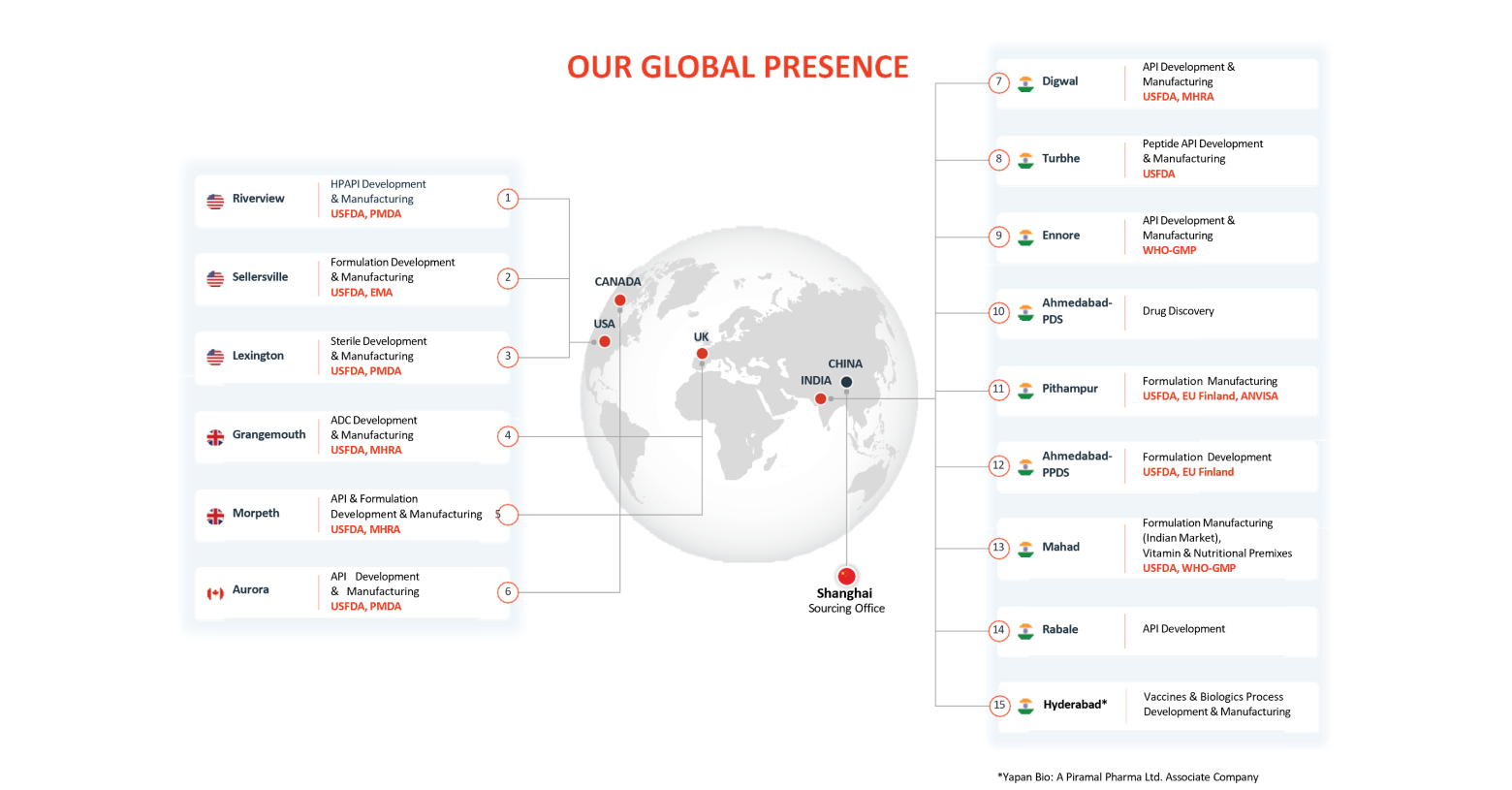
Piramal Pharma Solutions (PPS) is a Contract Development and Manufacturing Organization (CDMO) offering end-to-end development and manufacturing solutions across the drug life cycle. We serve our customers through a globally integrated network of facilities in North America, Europe, and Asia. This enables us to offer a comprehensive range of services including drug discovery solutions, process and pharmaceutical development services, clinical trial supplies, commercial supply of APIs, and finished dosage forms. We also offer specialized services such as the development and manufacture of highly potent APIs, antibody-drug conjugations, sterile fill/finish, peptide products and services, and potent solid oral drug products. PPS also offers development and manufacturing services for biologics including vaccines and gene therapies, made possible through Piramal Pharma Limited's associate company, Yapan Bio Private Limited.