

-1.png "HPAPIs image")
Highly Potent Active Pharmaceutical Ingredients (HPAPIs) continue to be a rapidly growing segment of the pharmaceutical industry. This is due to an increased focus on targeted therapeutics in disease areas such as cancer. Industry reports indicate that the global HPAPI market was $27.6 billion in 2024 and is expected to reach $53.2 billion by 2032.
The growth in antibody-drug conjugates (ADCs) boosts that forecast even further. They are becoming a greater contributor to the HPAPI market because their core active component, the payload, is typically classified as an HPAPI. ADCs are projected to grow from $240 million in 2022 to $538 million by 2030.2 This is reflected in an additional 220 clinical phase I and II programs and about 900 discovery or preclinical programs.
Any company looking to take part in the manufacture or the contracting of HPAPIs must be prepared to, or understand the requirement to, handle these potent compounds safely. These include having the appropriate facilities, procedures, controls, and expertise in-house to guarantee the safety of all personnel involved in the manufacturing, analysis, and handling required to produce these HPAPIs.
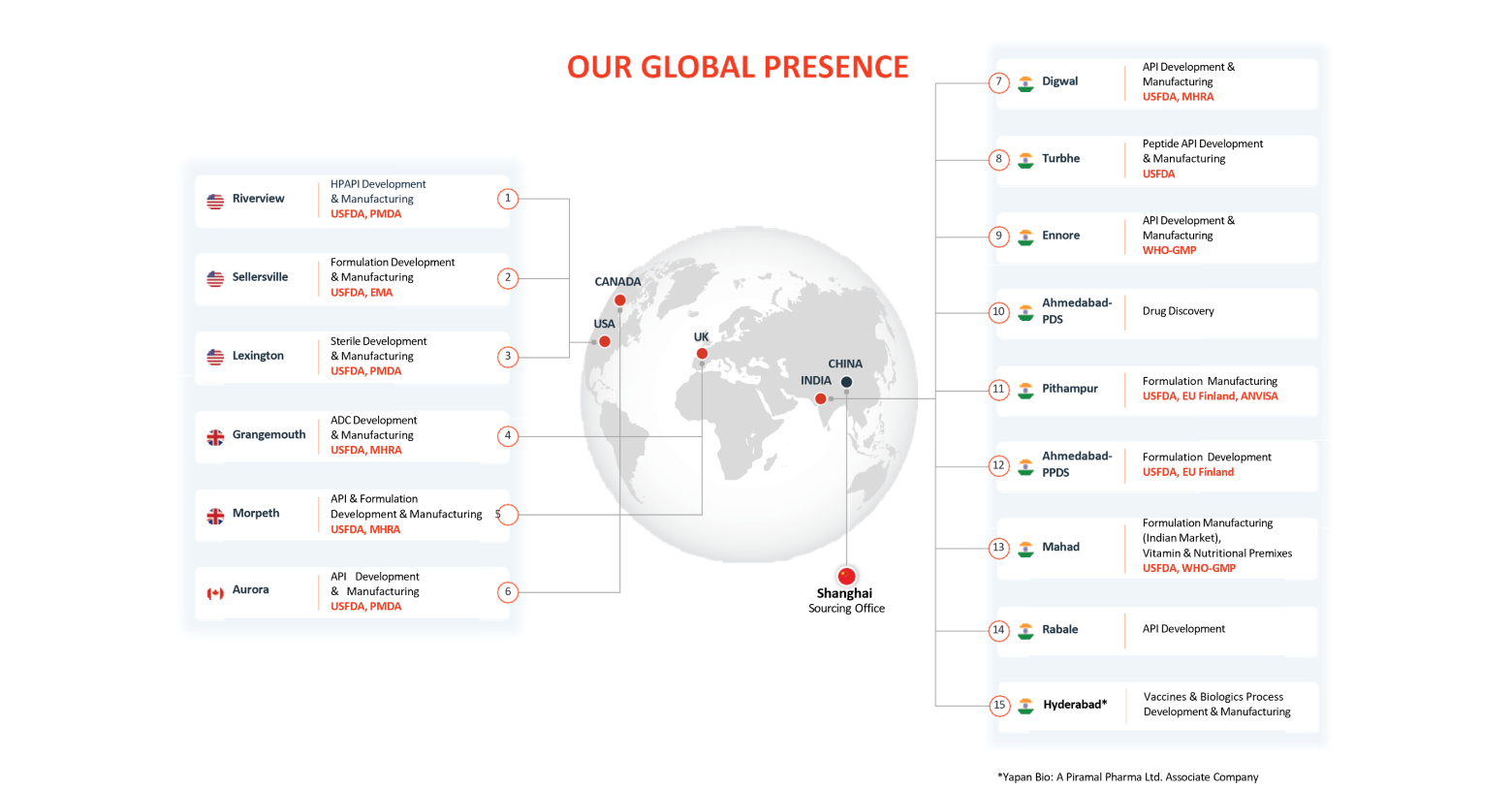
In many cases, pharmaceutical organizations rely on CDMO partners that possess both the capabilities and expertise to successfully and safely bring these drugs to market. Piramal Pharma Solutions is one such company, having launched several blockbuster oncology drugs over the past four decades at the site in Riverview, Michigan. The company also now offers payload manufacture based on auristatin and camptothecin from this site.
These payloads are conjugated to an antibody at its ADC site in Grangemouth, UK. ADCs are then formulated at its fill/finish facility in Sellersville, Pennsylvania.
There are some unique challenges associated with manufacturing HPAPIs, specifically due to their high potency and toxicity. To determine which containment strategies need to be put in place in a facility to properly handle a compound, a manufacturer must first determine the API's potency category to determine the needs to be associated with its handling.
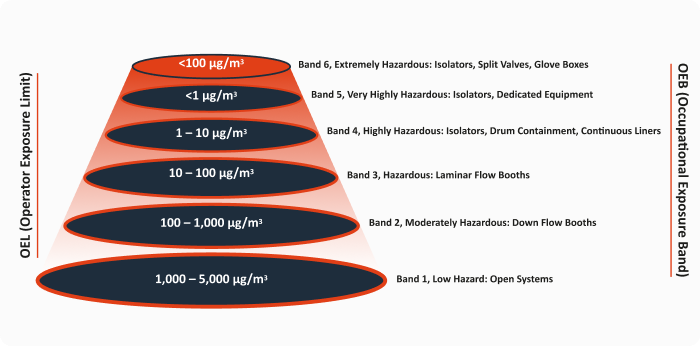
Together, the toxicology, safety and engineering departments must determine the compound's level of potency and the exposure limit, or the range the facility must keep the level below to maintain the safety of employees (i.e., an occupational exposure limit [OEL]). This is measured in units of mass per unit volume of air.
Occupational exposure bands (OEBs) are an alternative means to categorize the exposure limits for APIs or other compounds that do not have an established OEL and associate these categories to the use of containment methodology and personal protective equipment that are recommended to limit exposure to compounds to the range of each band.
There is no single industry standard banding system, but many companies have developed internal procedures and associated containment needs for Bands 5-6 as shown in Figure 1. The growing number of pharmaceutical companies entering the ADC field and the associated requirements for payloads and linkers, which are the core elements of ADC activity, has led to wider general use of Band 6, as many payloads have OELs below 100 ng/m3.
It is important to keep in mind that some names or banding denominations may be misleading and to ensure that the band numbering is exemplified by its OEL limits because some OEB systems show major variation on the limits and can lead to an incorrect containment strategy.
In addition, the use of ‘highly potent' terminology is not only linked to the OEB. Indeed, some organizations may advertise their HPAPI capability as being Band 4, while others, more versed with the handling of such a substance, limit HPAPI terminology to substances within Band 5 and above.
In the case of APIs in the early phase of the development, the OEB attribution must often be completed with a limited amount of information available. A couple of decades ago, the development approach was more sequential and the API was prepared in the early days because there were fewer preclinical activities to undergo.
Over the last decade, with the drive to bring the medicine to the patient more quickly, larger quantities of APIs, less well characterized in terms of potency, have to be delivered earlier. This supported a review of the default banding approach in the industry, leading most new molecules in the preclinical phase to be considered as part of OEB 4.
According to industry best practices, companies should ensure their facilities meet the required engineering controls for both plant and equipment items (such as air pressure relationships, containment and process technology) and program items (such as process safety, training, medical surveillance, industrial hygiene, toxicology and environmental control).
These specific engineering controls are applied from the facility level to individual pieces of equipment. At facility level, a company needs appropriate HVAC systems, airflow, and room pressurizations to control the area where the potent compounds should remain, whether in a room or within a piece of equipment.
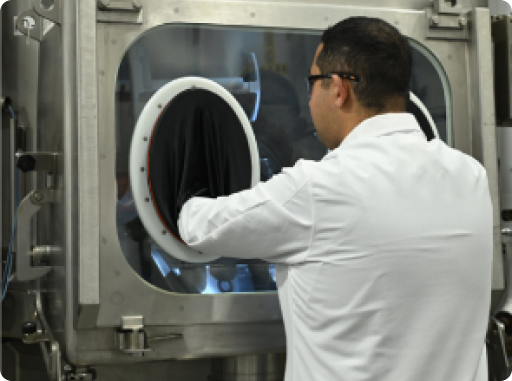
In terms of equipment, room and/or lab airlocks are necessary to control the movement of materials and equipment. One of the key improvements leading to a safer handling of the HPAPI has been the use of containment technologies. The development of isolators, gloveboxes and closed systems has revolutionized the safe handling of HPAPIs. These technologies minimize the risk of exposure to highly potent compounds, protecting both workers and the environment.
Nevertheless, once the facility and equipment controls are in place, a company should perform internal testing to measure the performance of its systems alongside the verification of the efficiency of standard operating procedures used to conduct the different handling procedures.
This is typically completed by the monitoring of an easily detectable placebo compound used during operation mimicking those involved for the handling during manufacture, bagging, or sampling of the potent compound to determine at what points, if any, HPAPI in powder or solid form is detected outside of the containment.
Such monitoring would typically include sampling collection on a person, in the room, in the airlock, or even in the clean area or hallway leading to it. Minimal levels may be detected, but the level should not exceed the standards set for the equipment being tested and recommended as suitable for a given OEL band.
The last point for consideration is related to analytical monitoring tools. As the OEL decreases, the capability of the analytical technology to quantify lower levels is paramount. While more and more single-use equipment is involved in HPAPI manufacturing, ‘carry-over' calculations between processes are required in order to demonstrate successful mitigation of cross-contamination.
Regulatory bodies are also requiring manufacturers to periodically demonstrate qualification of the containment efficiency and therefore the mitigated risk of cross contamination between batches of different HPAPIs, or worse, between HPAPIs and non-HPAPIs.
HPAPI manufacturing can be complex and requires the appropriate containment strategy and experienced work force. As part of any outsourcing program, it is necessary to identify a partner with the capacity and technical capabilities, as well as the experience. From a formal due diligence process to a more routine Project Needs Assessment, the critical attributes that a CDMO partner needs to demonstrate can be summarized as:
For more information contact:
Jean-Francois Carniaux
Vice President and Global API Technical Lead
Piramal Pharma Solutions
+44 7467 816719
Containment Challenges in HPAPI Manufacture for ADC Generation
Safe Handling of Cytotoxic Compounds in a Biopharmaceutical Environment
Piramal Pharma Solutions (PPS) is a Contract Development and Manufacturing Organization (CDMO) offering end-to-end development and manufacturing solutions across the drug life cycle. We serve our customers through a globally integrated network of facilities in North America, Europe, and Asia. This enables us to offer a comprehensive range of services including drug discovery solutions, process and pharmaceutical development services, clinical trial supplies, commercial supply of APIs, and finished dosage forms. We also offer specialized services such as the development and manufacture of highly potent APIs, antibody-drug conjugations, sterile fill/ finish, peptide products and services, and potent solid oral drug products. PPS also offers development and manufacturing services for biologics including vaccines and gene therapies, made possible through Piramal Pharma Limited's associate company, Yapan Bio Private Limited.