

-4.png "cyclic peptide synthesis image")
The distinct biochemical and therapeutic properties of cyclic peptides make them an attractive alternative to small molecules and antibodies in some therapeutic indications. After initially relying on natural peptides as a source of drug candidates, the pharma industry increasingly uses novel screening and cyclization strategies to find promising molecules. Yet while cyclic peptide discovery has advanced, drug developers continue to face problems as they try to establish efficient and scalable production processes.
The therapeutic use of cyclic peptides dates back to drugs such as gramicidin S, an antibiotic derived from a bacterial peptide that was discovered and used during the Second World War. Natural sources yielded more therapeutic cyclic peptide approvals over the following decades before novel technologies unlocked new ways to discover drug candidates.
Equipped with technologies such as phage display, researchers can today search large, diverse libraries of cyclic peptides to identify new drug candidates. Demand for better ways to discover cyclic peptides reflects the characteristics of the molecules, which can combine the stability of small molecules with antibodies' low metabolic toxicity and ability to bind targets with high affinity and specificity. Some cyclic peptides can be given orally, providing antibody-like effects in a more convenient dosage form.
With drug developers rapidly advancing cyclic peptides, there is a risk that a manufacturing bottleneck could constrain patient access to potentially life-changing molecules. In an industry that has traditionally focused on small molecules and antibodies, cyclic peptides pose unique manufacturing challenges that companies must address to ensure the reliable, scalable supply of high-quality molecules.
Piramal Pharma Solutions' Turbhe, India, facility is at the forefront of work on the manufacturability of cyclic peptides. With deep expertise in the development and commercial manufacturing of peptides using both solid-phase and solution-phase synthesis, the site provides multigram to kilogram-scale GMP peptides for clinical trials, along with a portfolio of peptide API products.
Harnessing those capabilities, the Turbhe team has created viable, scalable peptide synthesis processes to overcome problems that threaten to prevent promising programs from advancing toward patients. The projects have established a reproducible methodology for solving synthesis challenges and reducing manufacturing costs.
Case Study: Cost-effective Synthesis of a Complex Cyclic Peptide
The Turbhe site's successes include the development of a cost-effective and scalable synthesis strategy for a complex cyclic PEGylated peptide. Initially, the molecule was made using a conventional solid-phase peptide synthesis (SPPS) route on an acid resin with orthogonally protected amino acids.
The Problem
The initial solid-phase synthesis route encountered challenges typical of complex cyclic peptides, including incomplete chain assembly, sequence truncations, and process-related impurities generated during activation and coupling. These effects collectively contributed to lower crude purity, which generally fell within the expected range for difficult sequences. The poor quality of the crude peptide severely impacted purification recovery, and the inefficiency of the process drove up manufacturing costs.
Grappling with poor crude quality, low peptide content, and high manufacturing costs, the client asked Piramal to perform a thorough evaluation of the process to identify opportunities for yield improvement and cost reduction.
The client had four main goals: redesign the route of synthesis to enhance process efficiency minimize formation of low-quality crude material establish a reproducible and scalable synthesis process and achieve significant cost savings without compromising product quality or compliance standards.
The Solution
In response, the experts at Turbhe performed a detailed review of the existing synthetic route. The work led to the identification of critical stages contributing to poor yield and quality. As the analysis showed, one fragment in the sequence proved particularly challenging to assemble on solid support due to steric congestion, reduced accessibility and tendency to aggregate, which affected coupling efficiency. Those shortcomings drove the problems encountered when the client tried to use SPPS to make the peptide.
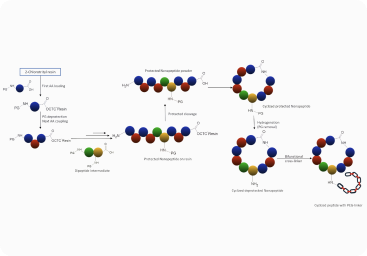
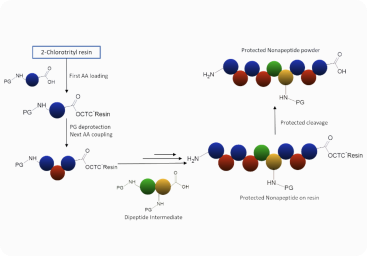
Having diagnosed the problem, the Turbhe team proposed a hybrid synthesis strategy. The team still used SPPS for part of the synthesis. However, instead of building the entire chain amino acid by amino acid on the resin, SPPS was used for the main chain assembly, and a challenging dipeptide
fragment was made using liquid-phase peptide synthesis (LPPS). Preparing the dipeptide fragment separately in solution provided better control over activation, reaction environment, and impurity management, resulting in higher-quality intermediate that improved the overall performance of the hybrid route.
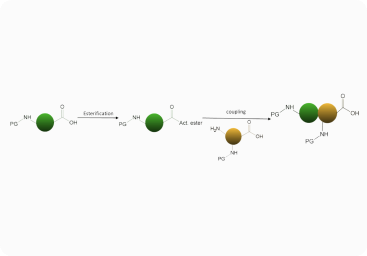
The acid was converted to an active ester before amine coupling to minimize side reactions. This pre-formed dipeptide was then coupled to the resin-bound chain. The hybrid method minimized side reactions and improved the quality of the dipeptide fragment compared to the original stepwise solid-phase assembly process.
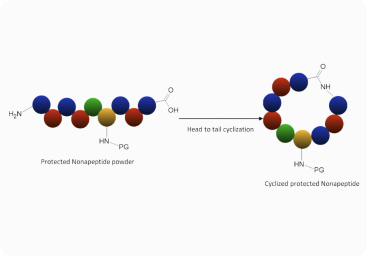
After completion of the resin-bound chain, the protected fragment was cleaved from the resin and subjected to head-to-tail cyclization under controlled conditions. Cyclization was performed in solution. Cyclization efficiency was found to be highly sensitive to solvent environment, reaction concentration and choice of base. Reaction parameters including solvent, concentration, and base selection were optimized to achieve intramolecular cyclization while minimizing oligomer formation. This step ensured structural integrity and improved overall yield.
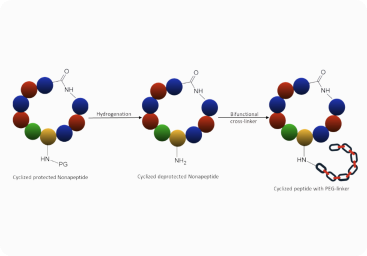
The cyclized peptide underwent selective hydrogenation to remove temporary protecting groups without damaging the cyclic core. Catalyst and solvent conditions were tuned to significantly shortened reaction time and reduced formation of a recurring side product. The bifunctional cross-linker was introduced under LPPS conditions. Because the modification was performed on the complete structure, the team avoided the need for linker protection and deprotection steps, thereby eliminating carryover impurities.
The fully assembled, protected sequence was subjected to global side-chain deprotection to yield the crude cyclic peptide. A one-stage purification process was sufficient to remove impurities and achieve high purity suitable for lyophilization and scale-up.
The Outcome
The structural integrity and purity of the final product were confirmed via LC-MS, HPLC, and NMR. The data showed that both crude and final materials exhibited higher yields and lower impurities than the prior linear approach.
Moving from linear SPPS to the hybrid LPPS model resulted in measurable improvements at every critical stage in the process. Optimized coupling and deprotection cleavage conditions improved crude quality and peptide yield. Converting acid to active ester before amine coupling during LPPS minimized side reactions, improved dipeptide quality, and increased overall yield.
Screening reagents, bases, and solvents enabled clean cyclization, while tuning catalyst, solvent, and hydrogenation conditions prevented impurity formation during hydrogenation. At the post-cyclization modification stage, performing final modifications on the complete structure avoided linker protection and deprotection steps to eliminate carryover impurities from Fmoc-protected linker coupling.
The combined impact of the changes was significant. Adopting the hybrid approach doubled the yield and reduced the cost by 50% to 60%. The changes cut raw material costs from $3,200 to $800 per gram, a 75% reduction. The process was scaled to produce over 180 grams of high-purity peptide.
As the figures show, the Turbhe team met the client's request for a reproducible and scalable synthesis process that achieved significant cost savings without compromising product quality or compliance standards.
The redevelopment of the complex cyclic PEGylated peptide validates Piramal's leading capabilities in hybrid peptide synthesis, impurity management, and scalable process development. Those capabilities are more important than ever. With cyclic peptides emerging as an attractive modality, companies need access to teams that can consistently solve synthesis problems to ensure their molecules reach patients.
Piramal is building on the project's success. In addition to enhancing the client's process efficiency, batch consistency, and downstream manageability, the work deepened the Turbhe team's understanding of impurity pathways, resin-switching effects, coupling behavior, and solvent/cleavage dependencies. Those insights delivered tangible value for the client and will benefit all future peptide programs.
Leveraging the insights, Piramal has created a template for future peptide programs, exemplifying how a commitment to data-driven optimization and cross-functional collaboration can drive scientific and commercial outcomes. Clients stand to benefit from the peptide template. Equipped with a proven framework, Piramal is poised to further accelerate and enhance peptide synthesis projects.
Those improvements will ultimately benefit patients. Supported by Piramal, drug developers can quickly identify and lower barriers to the scalable production of high-purity peptides, thereby stopping technical challenges from impeding the progress of an increasingly important treatment option.
| Stage | Challenge | Optimized Condition | Outcome |
| Peptide Synthesis (SPPS) | Poor yield after protected cleavage of peptide from resin. | Optimized coupling, deprotection cleavage conditions. | Improved crude quality and peptide yield. |
| Dipeptide Synthesis (LPPS) | Formation of side products leading to poor quality. | Converted acid to active ester before amine coupling. | Minimized side reactions, improved dipeptide quality, and higher overall yield. |
| Cyclization | Reagents related impurities. | Screened reagents, bases, and solvents. | Achieved clean cyclization. |
| Hydrogenation | Formation of unknown back-end impurity. | Tuned catalyst, solvent, and hydrogenation conditions. | Prevented impurity formation. |
| Post Cyclization Modification | Impurities from Fmoc-protected linker coupling. | Performed final modification on complete structure, avoiding linker protection/ deprotection steps. | Eliminated carryover impurities. |
| Overall Outcome | Low yield and high cost in linear SPPS route. | Adopted hybrid LPPS + SPPS approach. | Doubled yield and reduced cost by ~50-60%. |
Recent Advances in Cyclic Peptide Therapeutics
Cyclic Peptides for Drug Development
Advances in Peptide Cyclization Strategies
Piramal Pharma Solutions (PPS) is a Contract Development and Manufacturing Organization (CDMO) offering end-to-end development and manufacturing solutions across the drug life cycle. We serve our customers through a globally integrated network of facilities in North America, Europe, and Asia. This enables us to offer a comprehensive range of services including drug discovery solutions, process and pharmaceutical development services, clinical trial supplies, commercial supply of APIs, and finished dosage forms. We also offer specialized services such as the development and manufacture of highly potent APIs, antibody-drug conjugations, sterile fill/ finish, peptide products and services, and potent solid oral drug products. PPS also offers development and manufacturing services for biologics including vaccines and gene therapies, made possible through Piramal Pharma Limited's associate company, Yapan Bio Private Limited.