

-2.png "How In-House Starting Material Production De-Risks Drug Supply Chains")
Starting materials are vital to the reliable supply of high-quality medicines. As critical building blocks of active pharmaceutical ingredients (APIs), these materials influence everything from the purity of a product to the security of the supply chain. Yet, years of focus on upfront costs over systemic risks has driven the geographic concentration of suppliers and reduced drugmakers' control over the supply chain. With the risks now clear, the industry needs a new approach that supports control, quality, and cost efficiency.
API starting material is a term the International Council for Harmonization of Technical Requirements for Pharmaceuticals for Human Use adopted in 2000 to describe raw materials and intermediates that are incorporated as a significant structural fragment into an API.1 The terms key starting material (KSM) and regulatory starting material (RSM) are now widely used to describe the substances. RSMs mark the point from which companies must apply good manufacturing practices (GMPs).
Starting materials affect the impurity profile and regulatory risk of the drug substance. Companies that make bad choices about sourcing KSMs and RSMs expose themselves to threats that can cause expensive delays to drug product launches.
Starting materials were a focus of four of the top ten deficiencies that the European Directorate for the Quality of Medicines and Health Care identified when evaluating new applications for Certificates of Suitability for chemical purity in 2023.2 The two most common deficiencies were poor descriptions of the manufacturing process from the introduction of the starting materials and inadequate quality control specifications for intermediates and starting materials.
The choice of starting material also defines the resilience of the supply chain. Because starting materials are essential to API synthesis, disruption to KSM and RSM supply can cause drug shortages that prevent patients from accessing vital medicines.
Geographic concentration of starting material manufacturers has made supply chains more vulnerable to disruption. The U.S. Pharmacopeia (USP) found 41% of KSMs in U.S.-approved APIs are solely sourced from China.
USP cited amoxicillin, the second most prescribed oral antibiotic in the U.S., as an example of the hidden concentration of KSM supply. Manufacturers in countries including India, China, Austria, Spain, Italy, and Singapore make amoxicillin API, creating the impression of a diversified, resilient supply chain. However, API synthesis depends on four KSMs that are almost entirely made in China. Disruption to the supply of a KSM could create a shortage of an antibiotic the World Health Organization (WHO) views as essential.
Increasing recognition of the risks of geographic concentration is driving adoption of “China Plus One” strategies that ensure starting materials are available from manufacturers in at least two countries. The strategy mitigates the risk that disruption to trade with China will cause drug shortages.
However, the resilience achieved through supplier diversification comes at the cost of complexity, with the management of multiple starting material suppliers posing particular challenges to small biotech and pharma companies. Equally, companies that add third-party vendors still face problems related to supply chain control and transparency, creating a need for an alternative approach that addresses all the issues associated with sourcing KSMs.
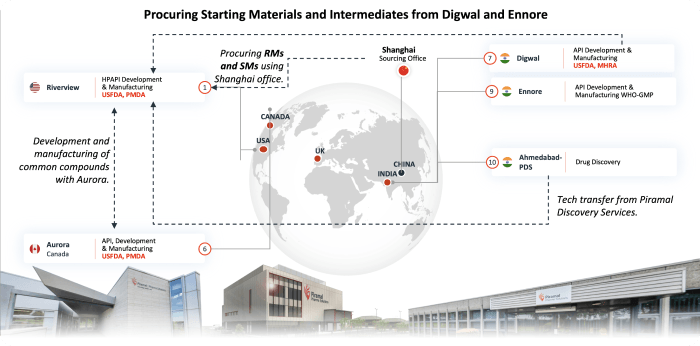
Piramal's integrated supply chain provides control, quality and cost efficiency. The company's API plants source KSMs and RSMs from Piramal facilities in India. Piramal's facility in Ennore, India is GMP certified by the WHO.
The plant operates at a larger scale than Piramal sites in North America and produces starting materials at a lower cost. Piramal also manufactures KSMs and RSMs at a facility in Digwal, India that is certified by the Food and Drug Administration, enabling it to make starting materials for the U.S. market under GMPs while still achieving cost efficiencies.
Being able to make starting materials at Ennore and Digwal gives Piramal flexibility. Piramal might begin making a starting material under GMPs at its facility in Riverview, Michigan, and if GMP conditions are later deemed unnecessary for the material, the company can move production to Ennore to cut costs. Equally, a project that starts at Ennore can move to Riverview or Digwal if GMP conditions are needed.
Because tech transfers are internal and sites are under the same quality system, Piramal can react nimbly to changes in requirements. The company's in-house network empowers customers to switch between North America and India and between GMP and non-GMP as needed. Piramal can qualify multiple sites, such as Ennore and Digwal, to provide a backup source of a starting material.
Some customers are comfortable with Piramal sourcing starting materials from a single facility within the Piramal network. At a time when many companies are pursuing resilience through diversification, the customers' willingness to rely on one site highlights another path to supply chain security. Customers recognize that Piramal's control of the facilities mitigates risks that would otherwise need to be controlled through diversification.
Sourcing starting materials from an internal facility gives Piramal more control. Unlike when relying on a third party, Piramal can set production timelines and guarantee that the supplier will not cut output or divert materials to another client. Piramal's API production plants set the specifications and timelines for starting materials made at the Ennore and Digwal facilities.
Information flows freely between the internal facilities. When working with a third-party site, companies can struggle to get the route of synthesis from the vendor. That becomes a problem as drug candidates advance through the clinic and on to the market, when companies need the route of synthesis. Piramal's starting material sites share every detail of their work, including the synthesis route and change controls.
Close ties between the API and starting material facilities are especially valuable when problems arise. Particularly in early development, companies may need to investigate starting materials and change their specifications to solve unexpected issues with the API synthesis.
Piramal brings together technical teams from its starting material and API facilities to identify the cause of a problem and design and implement solutions. The teams have a shared culture and work toward a common goal, supporting faster and more effective problem solving than is typical when collaborating with third-party sites.
The backward-integrated model simplifies administration and logistics for clients. Companies sourcing APIs from Piramal provide a purchase order. Piramal handles all the tasks involved in fulfilling the order, including sourcing starting materials from its internal facilities.
Because Piramal is forward-integrated, clients can go a step further and just provide a purchase order for a drug product. At Piramal, drug product orders can trigger a cascade of actions back through the API and starting material production plants. Starting materials become APIs that become finished products, all within Piramal's internal network of manufacturing facilities and from a single purchase order.
Growing recognition of the importance of controlling the supply of starting materials has emphasized the value of Piramal's integrated model. Having identified reliable starting material supply as a critical asset, biopharma companies are seeking out manufacturing partners with a level of integration that de-risks their paths to market.
Leveraging an internal network of facilities, Piramal offers the agility to shift production between sites or between GMP and non-GMP conditions as requirements evolve. Integration mitigates supply chain risks, simplifies logistics, improves transparency and supports timely problem solving. Ultimately, the benefits translate into the control and visibility needed to reliably deliver high-quality medicines to patients.
For more information contact:
Jean-Francois Carniaux
Vice President and Global API Technical Lead
Piramal Pharma Solutions (PPS) is a Contract Development and Manufacturing Organization (CDMO) offering end-to-end development and manufacturing solutions across the drug life cycle. We serve our customers through a globally integrated network of facilities in North America, Europe, and Asia. This enables us to offer a comprehensive range of services including drug discovery solutions, process and pharmaceutical development services, clinical trial supplies, commercial supply of APIs, and finished dosage forms. We also offer specialized services such as the development and manufacture of highly potent APIs, antibody-drug conjugations, sterile fill/finish, peptide products and services, and potent solid oral drug products. PPS also offers development and manufacturing services for biologics including vaccines and gene therapies, made possible through Piramal Pharma Limited's associate company, Yapan Bio Private Limited.