

-1.png "Photochemistry image")
Photochemistry, the study of chemical reactions initiated by light, has emerged as a powerful tool in modern chemistry. This white paper delves into the transformative potential of photochemistry in advancing synthesis processes, focusing on the pioneering work and expertise of Piramal Discovery Solutions (PDS). The application of photochemistry not only addresses synthetic challenges but also aligns with the principles of green chemistry, shortening a synthetic route, offering cost-effective and environmentally friendly solutions. Photochemistry is a viable synthetic strategy for producing Active Pharmaceutical Ingredients (APIs), from discovery all the way to commercialization.
Visible light photoredox processes have recently found many applications in organic synthesis,2–6 but the general interest in the field started much earlier.7 Unlike thermal reactions, photoredox processes occur under mild conditions and do not require radical initiators or stoichiometric chemical oxidants or reductants. Typical irradiation sources are LEDs or household lamps, which are cheaper and easier to apply than specialized UV reactors used in classical photochemistry.
Photochemistry traces back to antiquity but formally emerges in the 18th and 19th centuries, with early experiments by scientists like Scheele and Priestley investigating light's effects on substances.8 Photography development by Daguerre in the 19th century and quantum mechanics advancements in the 20th century laid the groundwork for modern photochemistry.9 The discovery of lasers in the 1960s revolutionized the field, leading to diverse applications in materials science and photochemical transformation.
Light-induced photochemistry, though likely present for eons on Earth, gained systematic scientific attention relatively recently. As light was utilized for distillation, the discovery of photochemical reactions became inevitable. Laboratory chemists were intrigued by color changes, gas evolution (as seen in photosynthesis), and less soluble photoproduct precipitation. Both accidental discoveries and intentional studies of various photochemical reactions laid the groundwork for systematic investigations, ultimately establishing photochemistry as a recognized branch of chemistry.
Photochemistry investigates how light drives chemical reactions by causing molecules to transition to higher energy states upon photon absorption. Quantum mechanics provides the theoretical framework for understanding these processes. Researchers analyzed reaction mechanisms to uncover pathways and kinetics of photochemical transformations. Energy transfer mechanisms like sensitized and quenching reactions further regulate these processes. Photochemistry finds applications in photobiology, supporting processes like photosynthesis and vision, and in materials science, enabling the creation of tailored materials for applications such as solar energy conversion and light-responsive materials. Understanding photochemistry is vital for developing new chemical entities, small drug like molecule, late-stage functional modification and scaffolds. Photochemistry emerges as an enabling tool for accessing and scaling up complex API molecules efficiently and safely.
Overall, photochemistry bridges fundamental science with practical applications, shedding light on the interaction between light and matter and driving innovations across disciplines.
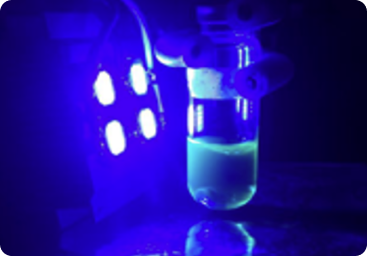
The team at Piramal Pharma Solutions' drug discovery site (PDS) in Ahmedabad, India regularly explores chemical transformations utilizing photochemical synthesis methods and has acquired expertise in conducting successful photochemical transformations. The PDS team invented a photochemical reactor assembly device: a light emitting diode (LED) based small photochemical reactor.
This reactor consists of an LED panel, an aluminum based heat sink, and a cooling fan (Fig. 1 and 2). PDS has patented this photochemical reactor14 and also demonstrated various types of photoredox reactions.
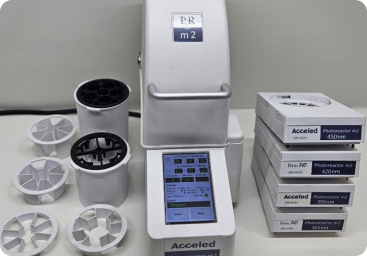
PDS equips its synthetic chemists with cutting-edge technologies like the Penn PhD Photoreactor M2 and a range of catalysts including Iridium, Ruthenium, Nickel, Eosin Y, and Riboflavin, providing precise control over reaction conditions. This advanced setup allows regulation of parameters such as light intensity and wavelength (365 nm, 395 nm, 420 nm, and 450 nm), vial size, multi-vial holder, and J-KEM® thermocouple to optimize reaction outcomes.
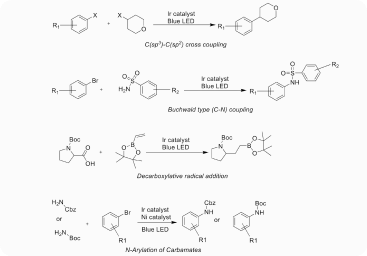
Using this sophisticated instrument, various types of photoredox reactions have been demonstrated, including C(sp3)−C(sp2) cross-coupling, decarboxylative fluorination, Negishi coupling, C-H arylation via C(sp3)-H bonds activation, decarboxylative arylation, alkylation, and C-N bond coupling (Fig. 5). To further enhance capabilities in this area, PDS has also acquired a UV-150 photochemical flow reactor equipped with the same wavelength lights as the Penn PhD Photoreactor M2.

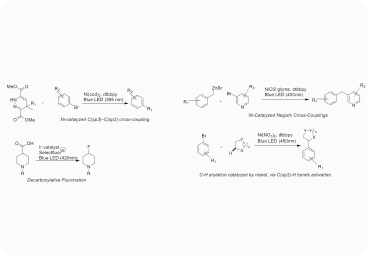
Photochemistry proves instrumental in modern synthesis, offering greener and more efficient routes. By harnessing light's energy, photochemistry offers sustainable solutions in the chemical field. Continued research in this area promises to unlock new technologies and deepen our understanding of light-matter interactions, emphasizing its enduring importance in science and technology. The PDS team in Ahmedabad showcases extensive expertise in photochemical synthesis, leveraging advanced technologies. In a concise conclusion, photochemistry emerges as a dynamic discipline, bridging fundamental science with tangible solutions, promising a brighter future for chemical synthesis and sustainability.
Piramal Pharma Solutions (PPS) is a Contract Development and Manufacturing Organization (CDMO) offering end-to-end development and manufacturing solutions across the drug life cycle. We serve our customers through a globally integrated network of facilities in North America, Europe, and Asia. This enables us to offer a comprehensive range of services including drug discovery solutions, process and pharmaceutical development services, clinical trial supplies, commercial supply of APIs, and finished dosage forms. We also offer specialized services such as the development and manufacture of highly potent APIs, antibody-drug conjugations, sterile fill/finish, peptide products and services, and potent solid oral drug products. PPS also offers development and manufacturing services for biologics including vaccines and gene therapies, made possible through Piramal Pharma Limited's associate company, Yapan Bio Private Limited.