

-2.png "greenness by design image")
The pharmaceutical industry is increasingly encouraged to deliver innovative therapies rapidly while embracing sustainable, environmentally responsible practices that ensure efficiency and safety in drug development. Traditional approaches often address sustainability late in the development procedure, leading to costly redesigns and operational inefficiencies. This white paper proposes a paradigm shift: integrating green chemistry principles at the discovery stage, specifically during hit-to-lead and lead optimization, to proactively design sustainable synthetic routes.
Early-stage synthesis offers unique opportunities to influence the environmental footprint of pharmaceutical manufacturing. By considering sustainability from the outset, chemists can avoid potential bottlenecks and liabilities that may arise during scale-up. The focus is on making judicious, decisions—such as solvent selection and procedure simplification—based on collective experience and established principles. These early interventions can significantly reduce the need for later reinvention and streamline the transition to manufacturing.
A successful program must balance three core priorities: speed, quality, and sustainability. Rather than viewing these as competing demands, this approach treats them as interconnected elements of a robust design strategy. “Greenness by design” ensures that rapid progression does not come at the expense of environmental responsibility or product quality. This white paper advocates for intentional, design-driven choices whenever possible that align with both customer expectations and regulatory requirements.
Technical Considerations and Practical Examples
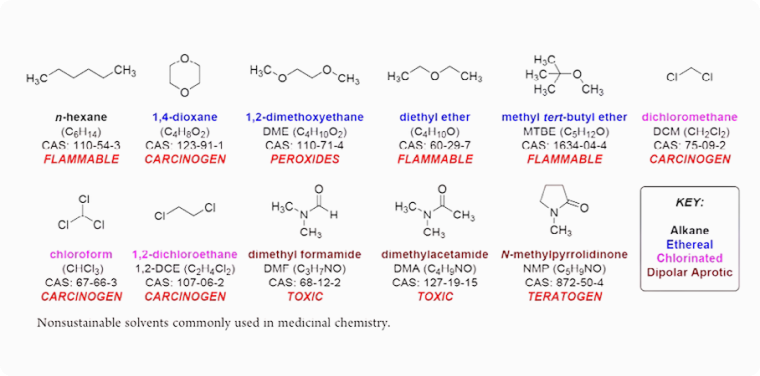
• Solvent Selection: The choice of solvents has a profound impact on both carbon emissions and ozone depletion. For example, tetrahydrofuran (THF) is highly carbonizing, while dichloromethane (DCM) is an ozone-depleting agent with poor recovery rates. Early-stage decisions to avoid or replace such solvents can yield significant sustainability benefits. It is recommended to plan the use of Class 3 solvents at the design stage.*
• Route Simplification: Eliminating unnecessary steps and optimizing reaction conditions can reduce waste and improve scalability. These “low-hanging fruit solutions” are best addressed at the beginning of the synthetic
design process.
* Class 3 solvents are residual solvents with low toxic potential, posing minimal risk to human health, and are considered safe for pharmaceutical use up to specified daily exposure limits.
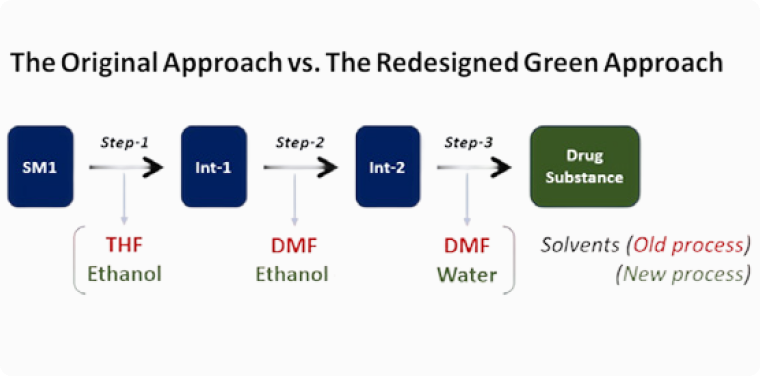
Case Study: Re-engineering a Drug Substance Synthesis Our project focused on optimizing the first three steps of a multi-step synthesis for a novel drug candidate, addressing environmental and safety challenges in scaling up from lab to multi-kilogram production. This example shows how selective steps in a synthetic sequence can be made greener, delivering tangible improvements even before the entire synthesis becomes fully sustainable.
Step 1: Solvent and Reagent Optimization for Cyclization
Original Approach: A key cyclization was initially mediated in tetrahydrofuran (THF). THF is flammable and prone to peroxide formation.
Optimized Green Approach: The procedure was redesigned to employ ethanol as the solvent.
Benefits Realized:
• Enhanced Safety Profile: Ethanol presents a markedly lower toxicity and flammability risk compared to THF.
• Route Efficiency: Ethanol proved an effective solvent for the cyclization, facilitating straightforward reaction work-up.
• Economic & Waste Impact: Ethanol is cost-effective and generates a less hazardous waste stream, simplifying disposal and reducing associated costs.
Step 2: Replacement of Dipolar Aprotic Solvent in Coupling Reaction
Original Procedure: A coupling reaction required N,N-dimethylformamide (DMF) as the solvent with a proprietary, costly base. DMF is a known reproductive toxin, and its high boiling point (153°C) necessitates significant energy input for removal and complicates waste management.
Optimized Green Approach: A solvent screen identified ethanol as a suitable replacement, paired with sodium hydroxide (NaOH) as an inexpensive, effective base.
Benefits Realized:
• Reduced Toxicity: Ethanol exhibits substantially lower toxicity relative to DMF.
• Improved Synthesis Efficiency: The lower boiling point of ethanol dramatically reduces the energy required for solvent distillation and product isolation, streamlining the unit operation.
• Cost & Waste Minimization: NaOH is inexpensive, and the resulting inorganic salts are more readily processed in standard waste treatment systems compared to complex amine-containing waste from the original process.
Step 3: Implementation of Aqueous-Phase SNAr Reaction
Original Approach: The final Nucleophilic Aromatic Substitution (SNAr) reaction was conducted in DMF, relying on the solvent's high polarity and boiling point, with attendant toxicity and energy penalties.
Optimized Green Approach: Solvent screening demonstrated that the reaction proceeds efficiently in water as the sole solvent. Although a heterogeneous mixture was formed, vigorous agitation provided excellent mass transfer, yielding superior purity and similar yield versus the DMF-mediated process.
Benefits Realized:
• Inherent Safety: Complete elimination of a toxic, high-boiling solvent.
• Minimized Environmental Impact: The use of water negates solvent-related aquatic toxicity and simplifies the waste stream to primarily aqueous efluent.
• Significant Economic Advantage: Water is inherently non-flammable, non-toxic, and presents a negligible raw material cost compared to anhydrous, reagent-grade DMF.
The traditional focus on solvent recovery is reframed as a consolation prize compared to the primary goal of good design. By prioritizing sustainability as a habit at the design stage, organizations can minimize the need for downstream remediation and achieve superior environmental outcomes. To reduce variability, accelerate technology transfer, and improve manufacturability, early-stage development activities should transition from a molecule-first focus to a process-aware approach. The Bridge is our framework for integrating process-development principles at clinical and pre-pilot scales, ensuring that critical parameters, scale-dependent sensitivities, and material attributes are evaluated earlier. This enables a smoother progression from laboratory feasibility to pilot demonstration and commercial implementation.
Piramal is committed to responsible innovation, ensuring that sustainability is embedded in every stage of the product lifecycle.Cross-functional collaboration between early stage discovery and API teams enables seamless transitions and scalable solutions. Clear communication, documentation, and shared intent underpin this integrated approach.
Integrating green chemistry principles at the earliest stages of synthesis is not only a scientific imperative but also a strategic advantage. By adopting a “greenness by design” philosophy, organizations can accelerate timelines, reduce costs, and deliver high-quality, sustainable products. This white paper outlines a practical, actionable framework for embedding environmental stewardship into the heart of pharmaceutical innovation.

Advancing Chemistry Sustainably: From Synthesis to Benefits and Applications of Green Synthesis
Green Chemistry Approaches in Pharmaceutical Synthesis: Sustainable Methods for Drug Development
Piramal Pharma Solutions (PPS) is a Contract Development and Manufacturing Organization (CDMO) offering end-to-end development and manufacturing solutions across the drug life cycle. We serve our customers through a globally integrated network of facilities in North America, Europe, and Asia. This enables us to offer a comprehensive range of services including drug discovery solutions, process and pharmaceutical development services, clinical trial supplies, commercial supply of APIs, and finished dosage forms. We also offer specialized services such as the development and manufacture of highly potent APIs, antibody-drug conjugations, sterile fill/ finish, peptide products and services, and potent solid oral drug products. PPS also offers development and manufacturing services for biologics including vaccines and gene therapies, made possible through Piramal Pharma Limited's associate company, Yapan Bio Private Limited.