

Oral bioavailability is a measure of the amount of an oral administered drug dose that is absorbed in the bloodstream. Many new chemical entities (NCEs) developed in the pharmaceutical industry have poor bioavailability because of either lower solubility or extensive first-pass elimination. Because of reduced bioavailability, these drugs need to be administered in higher doses, which may result in adverse effects for patients. It also makes dosage form development a challenge. Currently, sophisticated technologies such as spray drying and hot melt extrusion are acknowledged to improve solubility, and thus bioavailability, of active pharmaceutical ingredients (APIs). However, these approaches require the use of specialized equipment and may increase development time and product costs. Drug delivery systems that target the lymphoid system, such as lipid-based formulations (liposomes and solid lipid nanoparticles) are used to avoid first-pass metabolism, but these have their own challenges of stability, reproducibility, and scale-up. There are several more-straightforward formulation aspects to address the bioavailability problem.
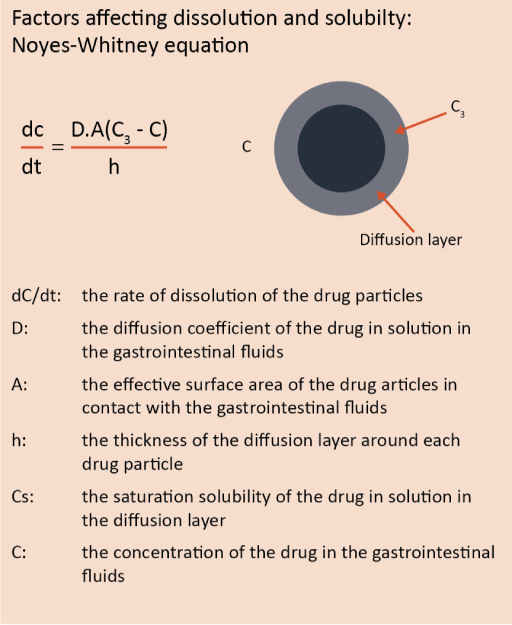
The particle size of an API plays an important role in solubilization/dissolution. Solubilization is directly proportional to the surface area of an API, which is inversely proportional to its particle size (see the Noyes-Whitney equation image below). Therefore, a reduction in the particle size of a poorly soluble API is the most direct approach to enhance dissolution during initial phase of formulation development.
API particle size can be reduced to micron and sub-micron levels by:
• Air jet milling
• Bead milling
• Spray drying
Of these, air jet milling is the most widely used, which uses high-velocity jets of gas to impart energy to particles for size reduction. Once the effect of the API particle size on its solubilization is established, scientists can confirm the improvement in bioavailability by performing in-vivo studies using selected dosage forms with a small number of animals or human subjects.
Surfactants
Surfactants are the agents that lower the interfacial tension between two liquids, between a gas and a liquid, and between a solid and a liquid. They can enhance solubility and thus improve bioavailability of API. There are three major types of surfactants: anionic, cationic, and non-ionic. Sodium lauryl sulphate and sodium stearate are examples of anionic surfactants. Benzalkonium chloride and cetylpyridinium chloride are cationic, and Tweens and Spans are non-ionic surfactants commonly used in formulations in the pharmaceutical industry. In addition, there are zwitterionic surfactants, which have cationic and anionic centers attached to the same molecule, including lauryldimethylamine N-oxide and lecithin. It is preferable to dissolve surfactants in a binder solution, which is then used to granulate the dry mix to ensure uniform distribution of surfactants in the formulation.
Microenvironmental pH
Another classic and cost-effective approach is to adjust the microenvironmental pH of the API. Most APIs are either acidic or basic, with a pHdependent solubility. Although the pH profile in the gastrointestinal (GI) track remains the same, that is, acidic in the stomach and basic in the small intestine and colon, the formulation's microenvironmental pH can be adjusted to increase drug solubility at the GI location where it is less soluble. Acidifiers include citric acid, tartaric acid, maleic acid, malic acid, and fumaric acid. Alkalizers include sodium carbonate, sodium bicarbonate, calcium carbonate, magnesium oxide, meglumine, and sodium hydroxide.
For example, organic acids such as citric acid and tartaric acid have been used successfully to maintain an acidic microenvironment in an immediate-release formulation of Ketokonazole to improve its solubility and thus bioavailability (Reference –‘'Improved dissolution and absorption of Ketoconazole in the presence of organic acids as pH-modifiers''. Adachi M, Hinatsu Y, Kusamori K, Katsumi H, et. al. Eur J Pharm Sci. 2015 Aug 30;76:225-30. doi: 10.1016/j. ejps.2015.05.015).
-(5).jpg "Enhancing Bioavailability When Developing OS Formulations")
Complexation is the association between two or more molecules to form a non-bonded entity with a well-defined stoichiometry. It relies on weak forces such as London forces, hydrogen bonding, and hydrophobic interactions. Inclusion complexes are formed by the insertion of the nonpolar region of one molecule (known as the guest) into the cavity of another molecule or group of molecules (known as the host). The cavity of the host must be large enough to accommodate the guest and small enough to eliminate water, so that the total contact between the water and the nonpolar regions of the host and the guest is reduced. Cyclodextrins (CDs) and their derivatives have been widely used as hosts to increase water solubility, dissolution rate, and bioavailability of several APIs. There are three naturally occurring CDs: α-cyclodextrin, β-cyclodextrin, and γ-cyclodextrin. The CDs that have improved aqueous solubility are preferred for pharmaceutical use. Examples of APIs that have had their solubility and bioavailability enhanced using CD include rofecoxib, celecoxib, clofibrate, melarsoprol, taxol, cyclosporin A, and carvedilol.
Solid dispersion (SD) is the scattering of one or more active ingredients in an inert excipient, a carrier, or a matrix where the API can exist in a finely crystalline, solubilized, or amorphous state. These can be prepared by spraying (on substrate), melting (fusion), or adsorption (on substrate) methods. Once the solid dispersion is exposed to aqueous media and the carrier dissolves, the drug is released as very fine colloidal particles with the greatly enhanced surface area, which is expected to increase dissolution rate and bioavailability of poorly water-soluble drugs.
Various pharmaceutical approaches for the preparation of SDs include fusion and solventdeposition; melt agglomeration; solvent evaporation; crystallization in aqueous solvent; use of adsorbent; kneading; supercritical fluid; lyophilization; hot melt extrusion; spray drying; and electrospinning. Of these, hot melt extrusion and spray drying are the most widely explored techniques. Alternatively, spraying, adsorption, and melt granulation are more executable approaches. With the spraying method, a mixture of API, carrier, and binder can be dissolved in solvent and sprayed onto a substrate such as sugar spheres or celphere beads/pellets. These can be filled in capsules or compressed with other excipients to form tablets. In the adsorption method, the API, carrier, and binder can be dissolved in solvent and added/poured onto substrate, such as aluminum magnesium silicate that has high adsorption potential. The powder/granules can be filled in capsules or compressed into tablets. With melt granulation, a jacketed granulator can be used to produce the granules that can be formulated as capsules or compressed tablets. Examples of APIs that have been studied using SD are meloxicam, naproxen, nimesulide, carbamazepine, celecoxib, and nevirapine.
Many drugs have a selective absorption window in the upper or lower small intestine. If the residence time at the absorption window is short, then the absorption of the drug would be incomplete, reducing its bioavailability. To improve GI residence time for such drugs, mucoadhesive and floating drug delivery systems are most commonly used. These are prepared with conventional processes such as direct compression, dry granulation, wet granulation, and coating. Some of the polymeric materials used to prepare mucoadhesive and floating dosage forms are hydroxypropyl methylcellulose (HPMC), polyethylene oxide, polymethacrylates, etc.
-(6).jpg "Gastroretentive Dosage Forms")
It has been well acknowledged that the bioavailability of a compound can be improved by designing liquid dosage forms such as parenteral preparations, solutions, and suspensions. Parenterals circumvent the metabolism step and, therefore, offer high bioavailability. With solutions and suspensions, the API is either in solubilized form (solutions) or dispersed as fine particulate matter (suspensions) and shows superior bioavailability over solid dosage forms. These formulations broadly use a solvent or vehicle, preservatives, flavors, and thickening agents.
Dissolving poorly soluble APIs in a non-aqueous solvent, such as oils, and filling a soft or hard gelatin capsule with them is a promising approach to improve bioavailability of compounds. However, the main drawbacks of liquid-filled capsules are that specific equipment such as liquid-filling and bandsealing machines are required and capsules are less cost-effective than tablet dosage forms.
-(7).jpg)
-(8).jpg)
Lipids have potential to alter biopharmaceutical properties of a drug, such as improved dissolution and solubility of APIs in the intestinal fluid through potentiating bile secretion, protection of the drug from degradation due to presence of oils, and formation of lipoproteins to promote lymphatic transport of highly lipophilic drugs. In the intestinal region, aggregated lymphoid follicles present as Peyer's patches. These patches offer a great opportunity to deliver the drugs to the lymphatic system via the oral route. There are a number of strategies to formulate lipid-based systems, including self-emulsifying drug delivery, liposomes, solid lipid nanoparticles, lipid-based liquid adsorption onto carrier, melt granulation, and the supercritical fluidbased method. Of these, adsorption onto solid carrier and melt granulation are the most direct and cost-effective techniques and present fewer stability, reproducibility, and scale-up challenges. Mono-, diand triglycerides have been widely used to formulate lipid drug delivery systems to im
Methods for improving bioavailability are constantly evolving. Selecting the proper approach is key to achieving a good formulation that reduces the frequency of dosing and improves patient compliance, as well as results in a low production cost. This depends upon drug characteristics, e.g., solubility, chemical nature, melting point, physical nature, absorption site, pharmacokinetic behavior, dosage form (viz. tablet, capsule, and liquid), strength, dissolution profile, regulatory requirements, approved excipients and analytical accuracy. Harnessing the experience of working on a variety of formulations, new formulation technologies, use of readily available processes in the commercial manufacturing environment, will yield the most direct approach and long-term success.
The team at Piramal Pharmaceutical Development Services (PPDS) in Ahmedabad, India, has deeply explored classic as well as specialized techniques for solubility and bioavailability enhancement of several drugs with poor solubility. Based on the knowledge acquired over many years, PPDS has developed decision trees to derive and assess the best suitable approach for solubility enhancement of drugs. PPDS looks closely at API physio-chemistry, dose, formulation complexities and breadth of applicability of the solubility enhancement techniques. PPDS uses a drug micronizer (air jet mill) to facilitate quick assessment of the impact of reduction in particle size of API on solubility and bioavailability enhancement. Moreover, in addition to classic techniques, PPDS uses a number of precise, specialized technologies including spray drying to create amorphous powders in combination with polymers for further processing, and fluid bed coaters with a range of batch sizes to coat a drug and polymer mixture onto a carrier as solid dispersion.
-(9).jpg "Solubility Enhancement at Piramal Pharma Solutions")
Piramal Pharma Solutions (PPS) is a Contract Development and Manufacturing Organization (CDMO) offering end-to-end development and manufacturing solutions across the drug life cycle. We serve our customers through a globally integrated network of facilities in North America, Europe, and Asia. This enables us to offer a comprehensive range of services including drug discovery solutions, process and pharmaceutical development services, clinical trial supplies, commercial supply of APIs, and finished dosage forms. We also offer specialized services such as the development and manufacture of highly potent APIs, antibody-drug conjugations, sterile fill/finish, peptide products and services, and potent solid oral drug products. PPS also offers development and manufacturing services for biologics including vaccines and gene therapies, made possible through Piramal Pharma Limited';s associate company, Yapan Bio Private Limited.