

-2.png "How integrated services convert validated molecules into defensible new chemical entities")
Starting a drug discovery program from a previously validated molecule is one of the fastest ways to reach the clinic. Existingsafety and pharmacological data shorten the regulatory path and structural familiarity reduces design uncertainty. 1 Yet, theintellectual property (IP) economics of the model are unforgiving. A molecule that closely tracks prior art offers weak IPprotection and method-of-use claims on a new indication can fail to defend a market position.
Drug developers that want both the speed advantage of a validated starting point and a defensible commercial asset needa discovery strategy that designs IP into the molecule from the outset. By co-locating chemistry and biology teams andembedding IP-aware design throughout drug discovery, integrated drug discovery (IDD) services empower companies torapidly turn validated starting points into novel, patentable chemical entities.

The commercial case for working from validated molecules is clear. Estimates of drug development costs per approved compound run into the billions of dollars, in part because safety, toxicology, and other factors drive high rates of attrition.3–5 Starting from a validated molecule cuts the risks because the mechanism is understood, the chemistry is tractable, and a body of data already exists.
Yet IP issues can erode the economic benefits of the approach. An analysis of approvals from 1985 to 2024 found that the current IP framework “often fails to adequately incentivize drug repurposing, as method-of-use patents and regulatory exclusivity periods may not provide sufficient protection for new indications.”
Method-of-use claims must clear the obviousness bar, and after the Supreme Court's KSR v. Teleflex decision, claims for indications that are predictable from a drug's known mechanism are vulnerable to challenge.6 Off-label prescribing further erodes exclusivity, as generic manufacturers can supply the molecule for its original, off-patent indication while physicians prescribe it for the new use.
Repurposing programs therefore need an IP foundation that goes beyond method-of-use. The most defensible route is to generate new composition-of-matter protection, designing a novel, patentable molecule optimized for the intended target, rather than just repurposing the original compound for a new indication. Scaffold modification enables that strategy.
Scaffold hopping and bioisosteric replacement give medicinal chemists the tools to generate novel chemical matter from a validated pharmacophore while preserving the biological activity that made the starting point valuable.
Bioisosteric replacement entails exchanging specific atoms or functional groups to create a new molecule with similar biological properties to the parent compound. Scaffold hopping involves replacing the core of the compound with a different chemical structure. These strategies have a long history, with researchers discussing scaffold hopping and the strategic use of isosteric replacements for key functional groups across a series of papers dating back decades.
The history of use reflects the potential for small changes to a molecule's structure to have big impacts, both in terms of the effects of a molecule and its IP. The PDE5 inhibitors sildenafil and vardenafil have two structural differences. Yet, vardenafil is over 20 times more potent than sildenafil for inhibiting purified PDE5 and has distinct IP.
The effect of two structural changes on vardenafil's potency illustrates both the potential of scaffold hopping and the need to carefully consider the impact of modifications.
Analogs must retain the drug-like properties of the validated molecule, necessitating the use of physicochemical filters such as Lipinski's Rule of Five. The Topliss decision tree, which guides systematic substitution patterns to optimize structure-activity relationships (SARs) with minimal synthetic effort, remains a foundational tool.
While chemistry is central to designing IP into molecules, it cannot in isolation manage the diverse challenges inherent in discovering drug candidates based on previously validated molecules. Real-time integration among medicinal chemists, biologists, and ADME specialists and awareness of the patent landscape are needed to realize the benefits of the strategy.
IDD services bring together the capabilities needed to design, execute, and interpret drug discovery programs based on validated molecules.15 With real-time feedback replacing asynchronous reporting, every chemical design decision is informed by the most recent biological data, and every biological observation can be tested against the next round of analogs.
The integrated model has particular benefits for scaffoldmodification projects. When starting from a validated molecule, companies run a series of design-make-testanalyze (DMTA) cycles to refine analogs with the desired potency and drug-like properties and establish new IP. Cutting the length and number of cycles accelerates progress, making continuous feedback loops that span multiple tightly integrated internal and external teams key to success. Slow handovers delay programs.
Piramal Pharma Solutions has organized its teams to accelerate the cycles, combining chemistry, biology, ADME, route scouting, and scale-up capabilities under one roof and project management team. With Piramal's partner offering DMPK and early toxicology services, the company provides and manages everything needed to ensure efficient workflows, robust data generation, and on-time decision making.
Teams share project ownership from the earliest design stage, compounds and data move quickly between functions, and design iterations can be informed by biological results in days rather than weeks. The model equips Piramal to progress programs seamlessly from hit identification to lead candidate selection.
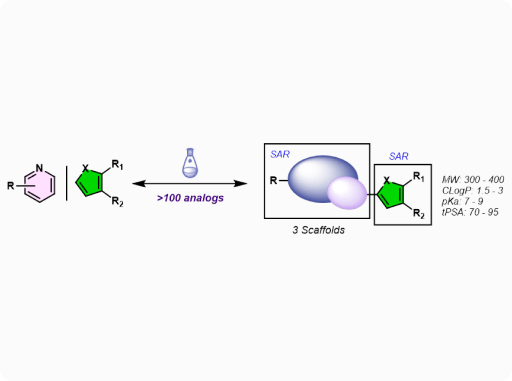
A recent six-month, accelerated medicinal chemistry campaign illustrates the real-world impact of the IDD framework. Piramal's client had a patented molecule with established pharmacological and safety data and wanted to navigate IP constraints while enhancing the biological performance of the parent compound.
Direct repurposing would have produced a method-ofuse claim with limited defensibility. Seeking to avoid that outcome, the company tasked Piramal with generating a new chemical series, optimized for the new indication and protected by new, defensible IP.
The program operated as a single integrated project team. The client supplied the original patented molecule, the new biological target, and high-throughput screening data. Piramal handled analog design, synthesis, biological screening, and ADME profiling, with continuous feedback between the internal and external teams. Every design iteration was informed by real biological data, creating a highly efficient and targeted discovery engine.
Strategic Analog Design
The first phase of the project focused on systematically modifying the original structure to generate novel, patentable matter. SAR analysis identified which regions of the molecule were critical for activity in the new indication and which could be altered without loss of potency to create new IP.
The primary design goal was to create analogs that were non-obvious and distinct from prior art, securing a strong, defensible IP position for the client. Strategic use of modern isosteric replacements was considered, and traditional Topliss decision tree principles were also applied during the design of new molecules.
All proposed analogs were filtered using Lipinski's Rule of Five, ClogP, TPSA, LE, and other key ADME parameters to ensure they maintained the desirable pharmacokinetic properties of a potential drug candidate.
Rapid Library Synthesis and SAR Expansion
The team executed a high-efficiency synthesis campaign to quickly explore the chemical space. More than 100 focused analogs were synthesized at a 50mg scale, enabling rapid biological testing without the time and resource investment of large-scale production.
Early data revealed that small heterocycles were well tolerated at the right-hand side of the molecular scaffold, which became a critical design element for expanding the patent estate alongside the novel core chemotype. The integrated structure of the project team allowed this SAR insight to flow directly into the next round of analog design without delay.
Lead Identification and Optimization
Biological screening data supported rapid triage of the analog library and identified more than 20 compounds with two- to four-fold improvements in biological activity over the original repurposed drug.
Selection of the scaffold for scale-up combined potency assessment with synthetic accessibility and physicochemical properties. Based on analysis, the team chose the bioisosteric thiazole series for further scaleup and advanced in vivo studies. ADME profiling of the lead compounds confirmed suitable drug-like properties for progression, de-risking the project ahead of in vivo investment.
Results and Impact
The team completed the hit-to-lead phase in six months, dramatically accelerating the client's development timeline. By the end of the accelerated project, Piramal had delivered a portfolio of novel, patentable compounds to secure the client's commercial position, plus a pipeline of potent leads with significantly improved activity for the new indication.
Piramal's client received scaled and ADME-profiled compounds ready for in vivo proof-of-concept studies, leading its CEO and CTO to commend the service provider on the successful execution of the program.
The project illustrated how a modern, IP-driven pathway can translate client-owned molecular assets into optimized, patentable new chemical entities. The fast-track, collaborative approach increased the molecule's biological performance while delivering value through reduced risk and accelerated development, positioning the client for clinical and commercial success.
Validated molecules will continue to be among the most attractive starting points in drug discovery. The reduction in risk, the opportunity to use existing data, and the shortened regulatory path make the approach more efficient than starting from scratch. Yet the benefits depend on building IP that can protect the product and support commercial success. A repurposing program that fails to build IP into the molecule risks achieving its scientific goals but missing the commercial opportunity.
Piramal's IDD service empowers clients to achieve their scientific and commercial goals efficiently and simultaneously. By integrating scaffold modification into its comprehensive IDD service, Piramal delivers compositionof- matter IP from clients' validated starting point on accelerated timelines. The timelines reflect Piramal's ability to shorten DMTA cycles by integrating medicinal chemistry, biology, ADME assessment, and IP-aware design, a model that equips the company to accelerate access to medicines.
For more information contact:
Sasikumar Kuttappan
Medicinal and Synthetic Organic Chemistry
Piramal Pharma Solutions
Piramal Pharma Solutions (PPS) is a Contract Development and Manufacturing Organization (CDMO) offering end-to-end development and manufacturing solutions across the drug life cycle. We serve our customers through a globally integrated network of facilities in North America, Europe, and Asia. This enables us to offer a comprehensive range of services including drug discovery solutions, process and pharmaceutical development services, clinical trial supplies, commercial supply of APIs, and finished dosage forms. We also offer specialized services such as the development and manufacture of highly potent APIs, antibody-drug conjugations, sterile fill/ finish, peptide products and services, and potent solid oral drug products. PPS also offers development and manufacturing services for biologics including vaccines and gene therapies, made possible through Piramal Pharma Limited's associate company, Yapan Bio Private Limited.