

-2.png "Supply chain resilience image")
Supply chain resilience is a competitive advantage and an ethical imperative. Amid rising geopolitical tensions, riskmitigation initiatives that began in response to regulatory changes in China have evolved into comprehensive supply chain resilience programs. Through the programs, pharma manufacturers are protecting patients from supply shortages and insulating customers from business continuity risks.
China emerged as a key player in the global pharma supply chain over the first two decades of the 21st century. From 2000 to 2023, China's share of active drug master files (DMFs) increased from 5% to 32%.1 China's leading role in the production of intermediates used to make active pharmaceutical ingredients means the DMF data underplays just how important the country is to global supply chains. By 2020, the European Union was estimated to be 85% to 90% dependent on China for pharmaceutical ingredients.
The risks of any one country having an outsized role in the supply chain started to become clear in 2018, when the Chinese government imposed stricter environmental and safety regulations on manufacturers. The changes and a reduction of export incentives and subsidies led to plant closures, forcing the pharma industry to adapt.
Subsequently, the stresses that the COVID-19 pandemic and geopolitical tensions put on operations reinforced the industry's understanding of how geographic concentration can make supply chains less resilient. At a time when trade wars have joined the list of threats to uninterrupted supply, companies cannot afford to become so reliant on one country that they cannot make a medicine without its materials.
The risks of remaining reliant on a country are clear. Supply disruptions that cause drug shortages can interrupt treatment with critical medicines and thereby negatively affect patient outcomes. There are business costs to supply chain disruptions too, with drugmakers' reputations and finances both liable to be harmed when companies fail to meet demand for their products.
Seeking to mitigate the risks, pharmaceutical companies have identified “China Plus One” as a strategic imperative. Under the risk-management model, companies diversify their supply chains to include at least one other country in addition to China. The approach allows companies to continue to benefit from China's manufacturing footprint while avoiding the risks associated with relying solely on one country.
Creating a risk assessment and prioritization framework can help companies identify ways to make their supply chains more resilient. The process entails mapping critical dependencies by product, volume, and therapeutic importance, identifying single-source vulnerabilities, and evaluating technical capabilities and regulatory requirements.
Using a three-parameter risk mapping methodology allows companies to evaluate the various ways that their supply chains could be threatened. The three parameters are: a critical vendor count based on business continuity risk, technical capacity or exclusive capability requirements for specific materials, and lead time advantages analysis.
Having identified risks, companies can begin to implement key strategies for supply chain diversification. The strategies include alternate vendor development in multiple geographies, backward integration for critical materials, strategic partnerships with custom synthesis providers, and inventory management and dual-sourcing policies.
Companies also benefit from switching to direct procurement from manufacturers rather than sourcing from traders. Working directly with manufacturers ensures the quality and consistency of supply. Other diversification policies include basket procurement strategies, prioritizing existing suppliers for multiple materials, and hybrid outsourcing models. Companies that adopt hybrid models can develop key starting materials (KSM) internally for transfer to specialty manufacturers.
The strategies form part of a broader approach to building sustainable and responsible supply chains. As companies work to make their supply chains more resilient, they can integrate environmental, social, and governance (ESG) considerations into supplier selection to realize additional benefits. Local sourcing that supports regional economies and supplier enablement and capability building can support ESG agendas.
Alignment with global standards can help companies develop sustainable and responsible supply chains. ISO 20400 provides guidance on integrating sustainability within procurement, while ISO 26000 covers how to approach accountability, transparency, and ethics when respect for society and the environment is seen as a critical success factor. UNGC, PSCI, and DJSI contain further advice for companies.
At Piramal Pharma Solutions, insights from the global standards have informed a four-pillar approach to sustainability. The four pillars are: sustainable procurement with policy framework, ESG risk screening for early-stage supplier assessment, supplier enablement through training and capability building, and collaboration and innovation for circular solutions.
Piramal developed its four-pillar approach to sustainability as part of the creation of a comprehensive supply chain resilience program. The company began a risk-mitigation initiative in early 2019 in response to regulatory changes in China. After assessing the extent and nature of threats to each raw material, Piramal evaluated custom synthesis partners and identified alternate vendors in India.
The actions enabled Piramal to mitigate risks to the supply of raw materials while avoiding any stock-out situations and manufacturing shortfalls. At the same time, the company reduced its raw material spend in China by 40% and achieved overall cost savings of 2% during a period in which the business grew 25%.
Having begun the initiative in 2019, Piramal successfully navigated the supply challenges that emerged in the COVID-19 years and exited the pandemic with the foundation for an expanded resilience program. As part of its expanding resilience activities, the company has implemented a comprehensive “China Plus One” strategy.
The implementation of the comprehensive strategy started with the formation of a cross-functional team and governance structure. Piramal designated the AVD lead as the single point of contact and scheduled weekly cadence calls to track its progress.
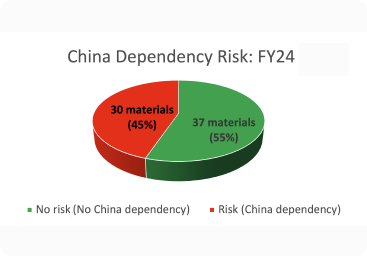
Through systematic risk mapping and material identification, the company flagged 67 critical KSMs or intermediates. Assessing its operations in the 2024 financial year, Piramal deemed 30 of the critical materials to be high risk because of its total reliance on China for supplies. The findings informed a phased approach to vendor development across India and the rest of the world.
Piramal worked to address the supply vulnerabilities by establishing integrated capabilities that enable resilience. That entailed adding in-house backward integration capabilities at multiple sites, leveraging technology transfer expertise to enable rapid supplier onboarding, and adopting direct manufacturing integration to reduce intermediary dependencies.
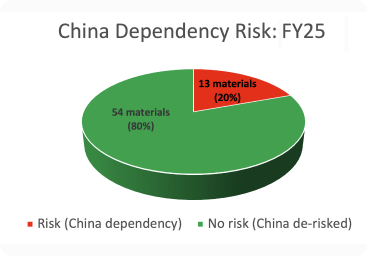
The strategy has enabled Piramal to quickly reduce its supply chain risks. By the 2025 financial year, the company had added alternate supply routes for 17 of the critical materials that relied solely on China just one year earlier. The actions reduced the proportion of critical materials without ex-China supply sources from 45% to 20%. Piramal is aiming to establish alternate supply routes for the remaining 13 critical materials in its 2026 financial year.
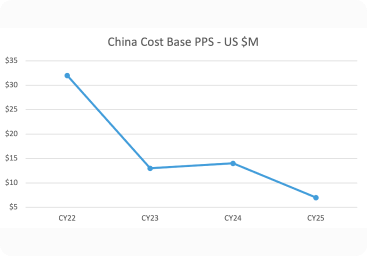
As well as working toward 100% resilience and improving supply security, Piramal has maintained cost competitiveness while providing uninterrupted supply of quality materials to ensure business continuity. The value of Piramal Pharma Solutions' sourcing from China has fallen quickly in recent years, declining from $32 million in 2022 to $7 million in 2025.
Piramal has integrated its “China Plus One” supply chain resilience program with its sustainability goals. Through the sustainability program, the company performed more than 80 desktop supplier reviews and five on-site supplier audits in its 2025 financial year. The activities were supported by the engagement of 86 global suppliers through virtual workshops.
Sourcing decisions are informed by Piramal's Sustainable Procurement Handbook. This practical guide enables buyers and category managers to evaluate environmental and social risks, embed sustainability into every request for proposal and contract, and adopt best practices in decision-making.
Piramal's focus on the sustainability of suppliers reflects the company's assessment of its environmental footprint. The assessment found Scope 3 carbon emissions are a major contributor to the company's environmental impact. Scope 3 is the term for indirect carbon emissions that occur in the upstream and downstream activities of an organization.
Recognizing the need to shape environmental actions at the companies it works with, Piramal launched a five-year emission reduction plan centered on supplier engagement, decarbonization training, and annual ESG disclosures.
High-value spend categories are a particular focus of the emission reduction plan. Under the plan, Piramal integrates sustainability considerations into every sourcing decision. The ethos is reflected in Piramal's prioritization of local and inclusive sourcing, support for micro, small and medium enterprises, and commitment to identifying materials with a lower environmental impact.
Piramal carries out early-stage ESG assessments of suppliers to identify risks and opportunities. Through the assessments, the company facilitates smarter sourcing and proactive risk management. Piramal helps suppliers reduce their environmental impact, meet evolving ESG standards, and drive long-term impact by offering structured training programs, workshops, and access to toolkits.
The support helps companies meet the mandatory standards that Piramal sets for suppliers. Through the Supplier Code of Conduct, the company mandates standards for human rights, labor, safety, anti-corruption, and environmental practices. Piramal enforces the ESG standards at its suppliers through contracts and governance.
As with its resilience activities, Piramal's ESG work with suppliers is a collaborative effort to improve the supply chain. Together, Piramal and its suppliers co-create circular solutions, reduce waste, and enhance resource efficiency across the value chain.
Piramal's resilience and sustainability agendas go beyond compliance. Seeking to make its supply chains more resilient, the company has formed mutually beneficial partnerships that support reliable provision of high-quality materials. Similarly, Piramal's sustainability work includes collaborating with suppliers to reduce waste and enhance resource efficiency across the value chain.
The initiatives are tackling some of the most impactful problems for patients. By increasing resilience, Piramal and its partners are ensuring that patients can reliably access high-quality medicines when they need them, regardless of the pressures the supply chain is facing.
Pharmaceutical Supply Chains: Risks, Challenges and Strategic Response
Improving End-to-End Traceability and Pharma Supply Chain Resilience using Blockchain

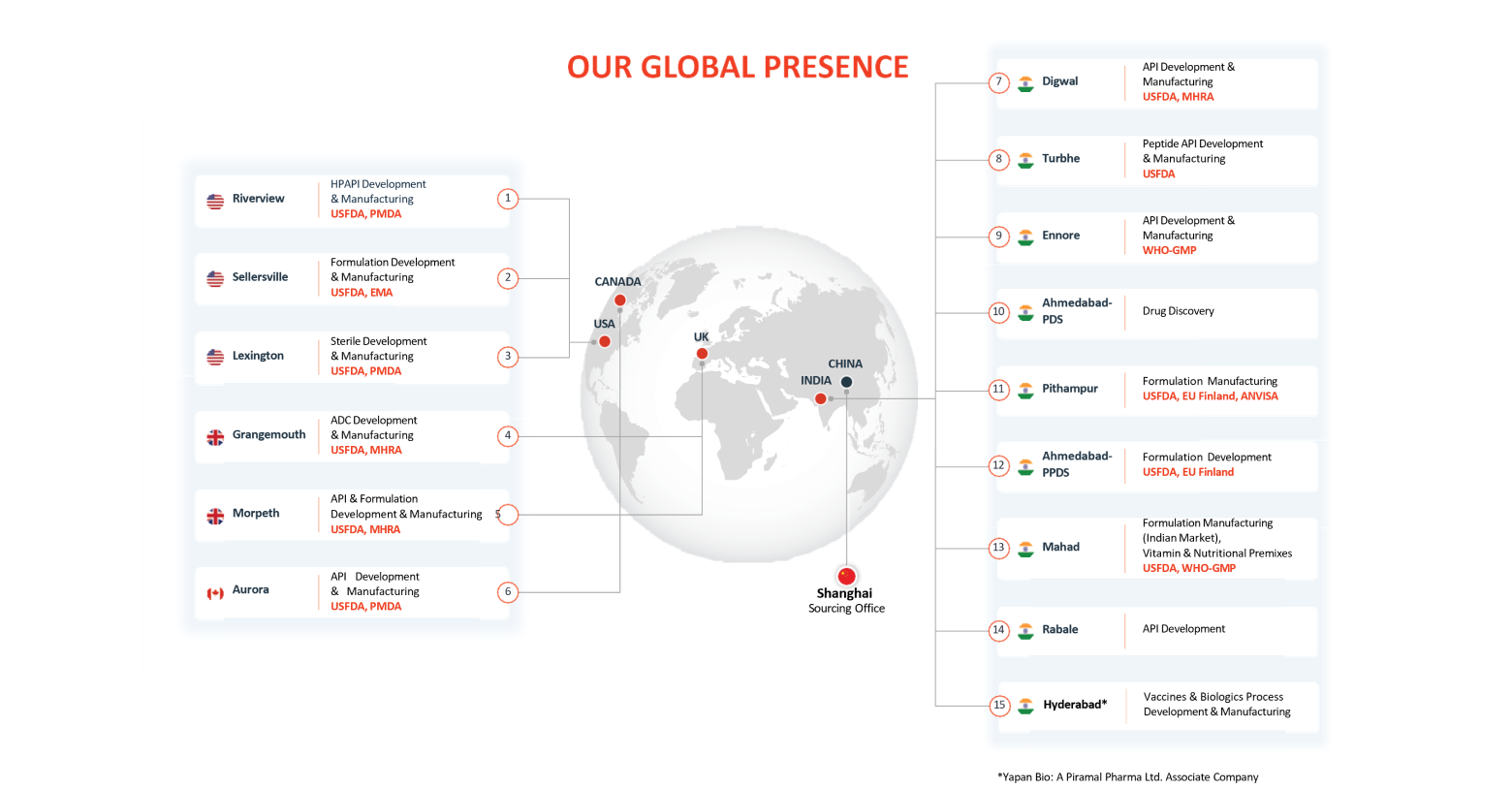
Piramal Pharma Solutions (PPS) is a Contract Development and Manufacturing Organization (CDMO) offering end-to-end development and manufacturing solutions across the drug life cycle. We serve our customers through a globally integrated network of facilities in North America, Europe, and Asia. This enables us to offer a comprehensive range of services including drug discovery solutions, process and pharmaceutical development services, clinical trial supplies, commercial supply of APIs, and finished dosage forms. We also offer specialized services such as the development and manufacture of highly potent APIs, antibody-drug conjugations, sterile fill/ finish, peptide products and services, and potent solid oral drug products. PPS also offers development and manufacturing services for biologics including vaccines and gene therapies, made possible through Piramal Pharma Limited's associate company, Yapan Bio Private Limited.