

-1.png)
Biocatalysis is a central pillar of modern organic synthesis. Using enzymes or whole cells as catalysts, researchers deploy biocatalysis to synthesize molecules in mild, environmentally-friendly conditions with high selectivity. The importance of the technique to modern drug development has made access to quick, cost-effective, and scalable biocatalysis the key to solving synthesis problems and positioning R&D programs for success.
The need to catalyze reactions has increased as the structures of active pharmaceutical ingredients (APIs) become more complex and companies place more emphasis on environmental considerations when designing synthesis routes. Chemocatalysis using metal catalysts can meet some of the needs, but metal-free biocatalytic reactions have advantages that support the use of the technique to replace or complement traditional methods.
Operating under mild conditions and delivering exceptional chemo-, regio-, and stereoselectivity, enzymes enable concise synthesis routes, minimize hazardous reagents, and align with green chemistry principles. Advances in genome mining, directed evolution, computational protein design, and de novo enzyme construction have expanded reaction scope and improved stability, solvent tolerance, and substrate breadth.
Today, biocatalysis supports industrially robust single-step reactions and multienzyme cascades, with growing adoption in pharmaceutical, agrochemical, and fine chemical manufacturing. This white paper describes biocatalyst sources and formats, a reaction toolbox, an integrated development framework, and the industrial impact, challenges, and outlook for the sector.
Typical biocatalytic reactions proceed at ambient temperature and pressure, tolerate sensitive functional groups and deliver high selectivity, reducing protecting-group manipulations and downstream purification. Those characteristics are central to the case for biocatalysis.
Enzymes enable asymmetric synthesis without complex chiral auxiliaries, resulting in high selectivity. The use of ambient temperature and pressure means biocatalyzed reactions use less energy and less specialized equipment than synthesis techniques, such as cryogenic reactions, reducing manufacturing costs. Eco-friendly credentials are further established by the lower solvent usage and minimal by-products that stem from the use of water as solvent in biocatalysis. Finally, late-stage functionalization is enabled by the tolerance of diverse functional groups.
While humans have used biocatalysis to transform chemicals for millennia – for example in brewing – its application to the synthesis of APIs is a more recent development. Over the last two decades, high-throughput sequencing, saturation mutagenesis, directed evolution, metagenomic mining, and in silico design have shifted biocatalysis from specialized use to routine practice across discovery and manufacturing.
The advances have fueled the spread of biocatalysis. Beyond single transformations, multistep enzymatic cascades compress step counts and improve atom economy a measure of the efficiency of a chemical reaction while enabling late-stage functionalization and precise stereochemical control. As robust enzymes become accessible via commercial catalogs and online sequence databases, biocatalysis is cementing its status as a designable and scalable technology for the construction of complex molecules.
The development of the biocatalysis sector over the past 20 years has made it faster and easier to explore the use of the technique. The availability of commercial enzyme panels, such as lipases, ketoreductases, and transaminases, enables rapid route scouting. Rather than spend time on enzyme engineering, researchers can use commercially available enzymes to ensure speed, cost-efficiency, and operational simplicity.
Researchers also repurpose biosynthetic pathways to adapt native enzymes to non-natural substrates, use metagenomic libraries to expand sequence diversity, and implement in silico mining and design to accelerate fit-for-purpose discovery. Collectively, the range of biocatalyst sources has expanded the utility of the technique while lowering barriers to using the method.
Multiple operational formats are available. Isolated enzymes offer high specificity and straightforward control of pH, temperature, and solvent, while immobilized enzymes enhance stability, boost reusability, and support the use of packed-bed and flow systems. Whole-cell catalysts such as engineered E. coli provide cofactor regeneration and support multienzyme pathways in vivo.
Companies have redefined optimal synthesis routes as they have integrated biocatalysis from route design to manufacturing plant. The technique has reshaped routes to chiral alcohols and amines, often delivering more than 99% enantiomeric excess while displacing precious-metal hydrogenations and chiral auxiliaries in the synthesis of APIs, such as statins. Peroxygenases and monooxygenases have enabled selective epoxidations and hydroxylations without using heavy metals. Nitrile hydratases power high-volume acrylamide production as a longstanding industrial benchmark.
The enzyme sources and formats have given researchers a biocatalytic reaction toolbox spanning redox, amination, oxidation, hydrolysis, nitrile/epoxide chemistry, and C–C bond formation. Researchers can perform a wide range of reactions, including enantioselective reductions of ketones to alcohols and the conversion of ketones to esters and lactones under mild, green conditions.
Companies are using biocatalysis in modern workflows that design routes natively around enzymatic logic, prioritizing steps where enzymes offer major advantages. Increasingly, teams are using digital tools to nominate enzyme classes alongside chemical steps. Hit-finding leverages commercial panels and sequence similarity networks for enzyme selection and engineering.
In representative chemoenzymatic routes to pregabalin and related APIs, biocatalytic steps reduce protecting-group manipulations, compress steps, improve stereocontrol, and lower waste, frequently improving cost of goods and manufacturing robustness. Process intensification via immobilized enzymes in continuous flow supports long on-stream times and steady quality.
Piramal's investments in biocatalysis are enabling biopharma companies to benefit from the technique. Staffed by professionals with experience applying biocatalysis to blockbuster drugs, Piramal's teams use off-the-shelf enzymes to solve synthesis challenges quickly and cost-effectively.
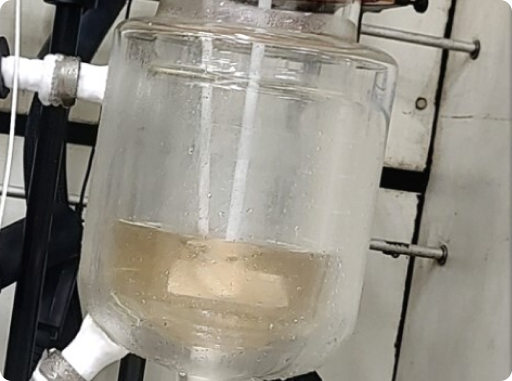
The investments have equipped Piramal to run biocatalytic reactions at small scales at its discovery site using equipment, such as glass reactors and round-bottom flasks with temperature and pH control and orbital shakers and incubators for whole-cell reactions. As projects scale up, Piramal can move reactions to development sites with jacketed stirred-tank reactors and in-line pH and temperature control to enable the production of larger quantities of drug substance.
Piramal's discovery and development facilities have proven their ability to perform a range of biocatalytic reactions at various scales. The following case studies cover some of the ways Piramal has used biocatalysts to achieve its synthesis goals.
| Reaction type | Transformation | Enzyme classes | Process notes |
| Asymmetric reduction | Ketones → chiral alcohols | KREDs, ADHs | >99% ee; mild conditions |
| Asymmetric amination | Carbonyls → chiral amines | ATAs | Eliminates resolution steps |
| Reductive amination | Imines/carbonyls → amines | IREDs, RedAms | One-pot; high chemoselectivity |
| Selective oxidation | Alcohols/alkenes → ox./epox. | Oxidases, P450s, peroxygenases | Metal-free; site-selective |
| Baeyer–Villiger | Ketones → esters/lactones | BVMOs | Green alternative to peracids |
| Hydrolysis/resolution | Esters/amides → optically pure products | Lipases, esterases, amidases | Robust in organic media |
| Nitrile conversions | Nitriles → amides/acids | NHases, nitrilases | Benchmark industrial scale |
| C–C bond formation | Aldol/lyase couplings | Aldolases, lyases | Multiple stereocenters |
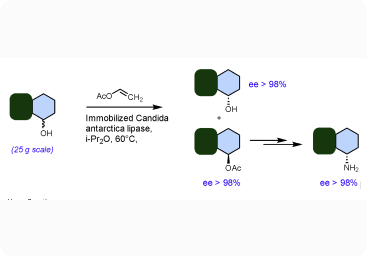
Vinyl Acetate as Acetyle Donor in Reaction
Piramal used an enzyme derived from yeast in a 25g scale vinyl acetate reaction. Applying immobilized Candida antarctica lipase to a mixture with unknown stereochemistry in diisopropyl ether at 60°C, the team converted the alcohol to an acetate with greater than 98% enantiomeric excess. The researchers further processed the highly pure chemical to create an amine that retained the enantiomeric excess of more than 98%.
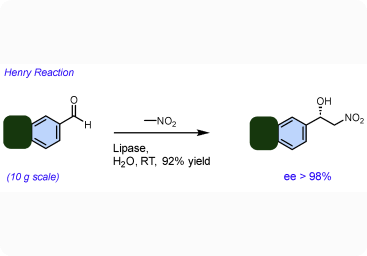
The Henry reaction, also known as a nitroaldol reaction, is a mainstay of organic synthesis that is used to synthesize the β-nitroalcohols that are key building blocks for API synthesis. A range of catalysts, such as transition metal complexes, can catalyze the reactions, but many create undesired side products. Pressures to minimize side reactions have fueled research into using milder conditions.
Piramal showed biocatalysis can make the Henry reaction viable in milder conditions. Using lipase, the team catalyzed the formation of a carbon–carbon bond to create a β-nitroalcohol with more than 98% enantiomeric excess.
The reaction used water as a solvent and happened at room temperature, validating the ability of the biocatalyst to facilitate green chemistry. The 10g scale reaction had a 92% yield.
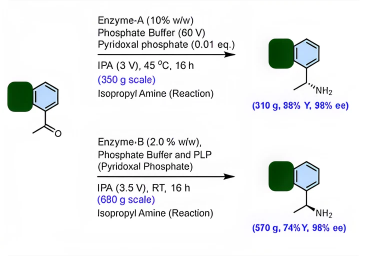
Stereodivergent Synthesis
Beginning with a single starting material, Piramal used different enzymes and reaction conditions to make two enantiomers. One reaction used substances including the coenzyme pyridoxal phosphate and the solvent IPA* to make 310g of an isomer with 88% yield and 98% enantiomeric excess.
In the second reaction, Piramal used a different enzyme, and conditions to convert the same starting material into another isomer. Run at room temperature for 16 hours, the reaction yielded 570g of the desired molecule with 98% enantiomeric excess. The example shows how Piramal can change a biocatalyst and reaction conditions to generate mirror-image products with very high purity from a single starting material.
A commercially and economically viable process was developed at the Piramal site using the enzyme ketoreductase. Using this process, the product has the potential to scale to multi-ton capacity. Bottlenecks that are often seen in enzyme processes, such as product inhibition, low throughput, and mass transfer limitations, can be overcome through process solutions and engineering expertise.
The case studies illustrate how biocatalysts play a central role in the development of scalable reaction routes that yield molecules with high selectivity. However, the sector must overcome outstanding challenges to fulfill the full potential of biocatalysis. Key challenges include substrate scope limitations for non-native scaffolds, inhibition at high substrate loads, stability under process-relevant media and temperatures, cofactor economy, and compatibility in multienzyme cascades.
Work to address the challenges is underway. Convergent solutions combine directed evolution with computational design to deliver stable, solvent-tolerant, high-activity enzyme variants. Other groups are working on hybrid chemoenzymatic designs that leverage the best of both catalysis domains, continuous manufacturing with immobilized enzymes and packed-bed reactors, and digitalization for data-driven selection and predictive performance modeling.
The innovations are empowering chemists to transform route design and industrial manufacturing using biocatalysis. By partnering with Piramal to access biocatalysis expertise, pharma companies are advancing sustainability, cost efficiency, and speed to market to bring high-quality, life-changing medicines to patients.
Implementation of biocatalysis processes faces regulatory challenges and needs to demonstrate the absence of enzymes in the product. Piramal has well-established analytical procedures and methods to demonstrate the absence of enzymes and cofactors.
For more information contact:
Sasikumar Kuttappan
Head of Chemistry:
Medicinal and Synthetic Organic Chemistry
Piramal Pharma Solutions
Power of Biocatalysis for Organic Synthesis
Advancements in biocatalysis: A comprehensive review of applications in organic synthesis
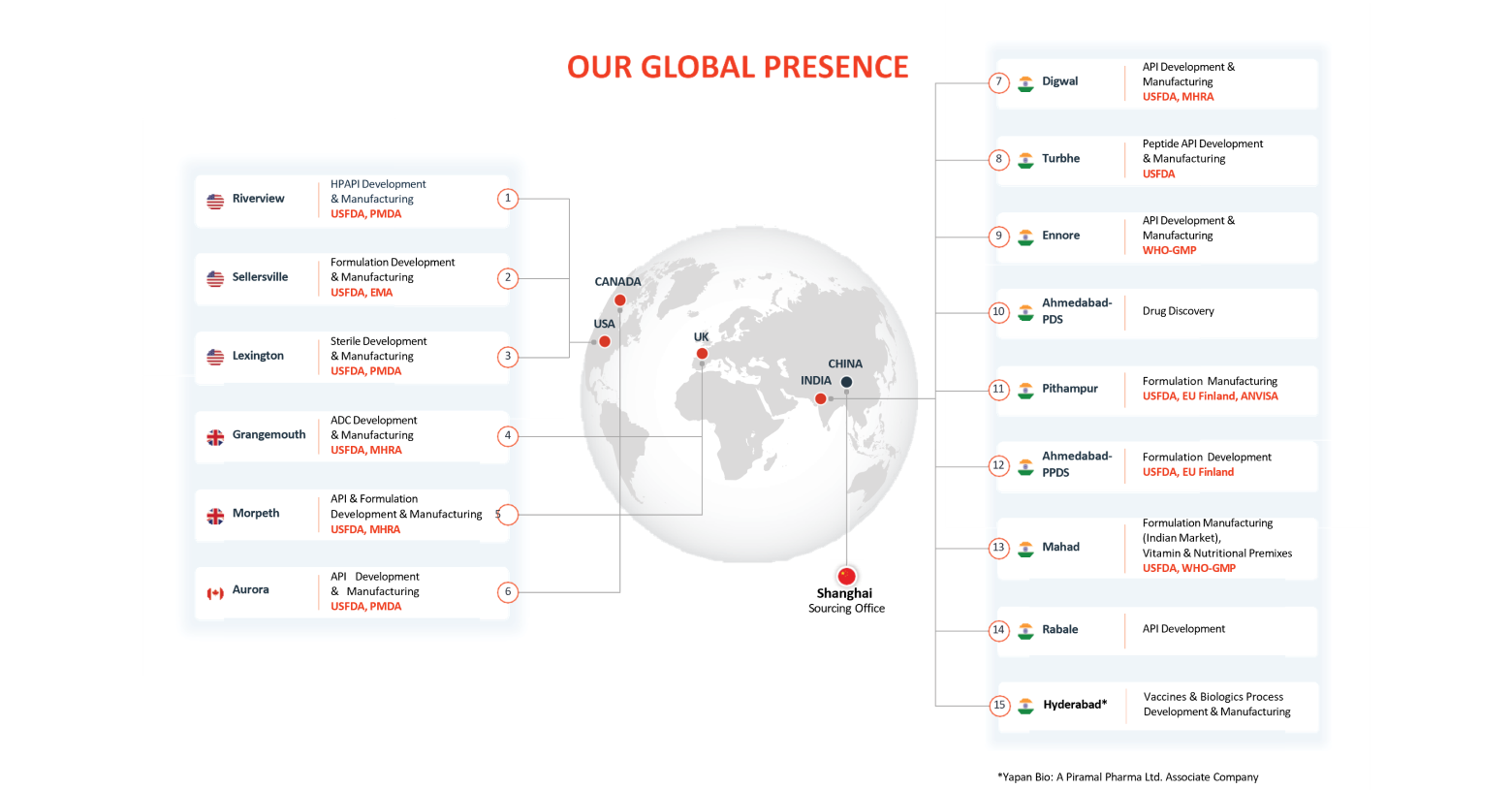
Piramal Pharma Solutions (PPS) is a Contract Development and Manufacturing Organization (CDMO) offering end-to-end development and manufacturing solutions across the drug life cycle. We serve our customers through a globally integrated network of facilities in North America, Europe, and Asia. This enables us to offer a comprehensive range of services including drug discovery solutions, process and pharmaceutical development services, clinical trial supplies, commercial supply of APIs, and finished dosage forms. We also offer specialized services such as the development and manufacture of highly potent APIs, antibody-drug conjugations, sterile fill/ finish, peptide products and services, and potent solid oral drug products. PPS also offers development and manufacturing services for biologics including vaccines and gene therapies, made possible through Piramal Pharma Limited's associate company, Yapan Bio Private Limited.