


-1-(1).png "ASSESSMENT AND CONTROL")
Extractables and leachables (E&L) represent an important class of impurities in pharmaceutical products that may arise from interactions between drug formulations and packaging materials, manufacturing components, or delivery devices. These substances may migrate into drug products during manufacturing, storage, or administration, potentially impacting product quality, stability, and patient safety.
Global regulatory authorities increasingly require systematic assessment and control of E&L impurities as part of pharmaceutical development programs. The International Council for Harmonisation (ICH) has introduced the ICH Q3E guideline to provide harmonized expectations for identification, qualification, and control of extractables and leachables.
This white paper presents a comprehensive framework for implementation of the ICH Q3E guideline using a risk-based and science-based approach. It also covers extractables and leachables concepts, sources, analytical methodologies, risk assessment strategies, analytical evaluation thresholds (AET), analytical uncertainty factors (AUF), and toxicological safety
assessment approaches.
A holistic life cycle strategy integrating analytical chemistry, toxicology, and quality risk management is proposed to ensure regulatory compliance and patient safety. The paper also outlines practical workflows used in pharmaceutical organizations for effective management of E&L risks.
Pharmaceutical products are typically packaged and delivered using complex container closure systems and drug delivery devices composed of materials such as polymers, elastomers, glass, and metals. These materials often contain additives introduced during manufacturing, including stabilizers, antioxidants, plasticizers, curing agents, lubricants, and catalysts. Under certain conditions, these additives or degradation products may migrate from packaging materials into the drug product. These migrating chemical species are referred to as leachables, while compounds that can potentially migrate under aggressive laboratory extraction conditions are known as extractables.
The presence of these compounds may have implications for drug product safety, stability, and efficacy. Therefore, pharmaceutical regulatory authorities have increasingly emphasized the need for systematic identification and control of extractables and leachables during drug development.
Historically, industry guidance for E&L assessment was provided by organizations such as the Product Quality Research Institute (PQRI) and the United States Pharmacopeia (USP). The introduction of ICH Q3E provides a harmonized global framework for managing extractables and leachables across regulatory regions.
This white paper discusses practical implementation of ICH Q3E and provides guidance for establishing an integrated E&L assessment program. Extractable and leachable study is critical to product quality, patent safety, and regulatory perspective.

E&L compounds interact with formulations, altering potency or compromising device performance

Leachables may be toxic or carcinogenic. Even trace amounts can trigger serious allergic reactions

Notable recalls from rubber stoppers and IV bags carry significant regulatory and financial repercussions

Unintended chemical interactions affect shelf-life, reducing efficacy or creating harmful by products
.png "Extractables and Leachables differnce image")
Extractables and leachables assessment applies to a wide range of pharmaceutical products and packaging systems. These include oral solid dosage forms, parenteral formulations, inhalation therapies, ophthalmic products, transdermal patches, and nasal drug products.
The scope of E&L evaluation extends beyond primary packaging materials and includes components involved in the manufacturing process such as filters, tubing, and processing equipment. Drug delivery devices including inhalers, syringes, and infusion systems may also contribute potential extractables and leachables.
Evaluation of E&L risks requires consideration of multiple factors, including the route of administration, patient exposure levels, formulation characteristics, and duration of contact between drug products and packaging materials.
ICH Q3E emphasizes the use of a risk-based approach to determine the appropriate level of testing required for different product categories.
A simple comparison illustrating how extractables and leachables are differentiated is given in Figure.
Potential sources of extractables and leachables include container closure systems, manufacturing components, and drug delivery devices. Common examples include rubber stoppers, plastic bottles, elastomeric seals, gaskets, adhesives, and polymer coatings. Examples of typical sources are depicted in Figure.
Manufacturing equipment, such as tubing, filters, pumps, and storage vessels, may also introduce chemical substances into drug products during processing.
In addition, delivery devices, such as inhalers and transdermal systems, may contain multiple polymeric components that could contribute extractables.
Factors influencing the migration of chemical species include the chemical composition of the packaging material, the formulation properties of the drug product, contact time, temperature, surface area, and solvent characteristics.
Understanding these factors is critical for effective risk assessment and control strategies.

Monomers and oligomers from plastic packaging materials can extract into drug products, especially under stress conditions

Antioxidants, plasticizers, UV stabilizers, and other formulation components added to improve material properties

Catalysts, coadjuvants, release agents, and other manufacturing aids used in component production

Compounds formed through material aging, sterilization, or exposure to heat, light, or oxygen
ICH Q3E recommends a structured, risk-based approach for the evaluation of extractables and leachables. This approach integrates principles of quality risk management to prioritize testing efforts based on potential patient risk.
Key factors considered in risk assessment include the route of administration, dosage for characteristics, duration of patient exposure, and likelihood of interaction between the drug product and packaging materials.
For example, inhalation products and parenteral formulations typically represent higher risk categories because they bypass physiological barriers and deliver substances directly into systemic circulation. Conversely, oral solid dosage forms generally present lower risk due to reduced likelihood of interaction between packaging components and the drug product.
A risk matrix is often used to categorize packaging components according to their potential risk level and guide analytical testing strategies.
Examples of packaging concerns for common classes of drug products are shown in Table.
| Degree of Concern Associated with the Route of Administration | Likelihood of Packaging Component-Dosage Form Interaction | ||
| High | Medium | Low | |
| Highest | Inhalation Aerosols and Sprays | Injections and Injectable Suspensions; Inhalation Solutions | Sterile Powders and Powders for Injection; Inhalation Powders |
| High | Transdermal Ointments and Patches | Ophthalmic Solutions and Suspensions; Nasal Aerosols and Sprays | - |
| Low | Topical Solutions and Suspensions; Top-ical and Lingual Aerosols; Oral Solutions and Suspensions | - | Oral Tablets and Oral (Hard and Soft Gelatin) Capsules; Topical Powders; Oral Powders |
Extractables studies are conducted to identify potential chemical entities that may migrate from packaging materials under exaggerated laboratory conditions. These studies employ aggressive extraction conditions, including strong solvents, elevated temperatures, and extended extraction durations.
The objective is to release a comprehensive set of potential extractable compounds without chemically altering the material being tested. Multiple extraction solvents are typically selected to represent a range of polarity and pH conditions relevant to the drug product formulation.
Common extraction techniques include maceration, reflux extraction, Soxhlet extraction, sealed vessel extraction, and sonication. Selection of extraction conditions should represent worst-case scenarios for potential leaching while maintaining chemical integrity of the extracted compounds.
Extractables assessments associated with pharmaceutical packaging/delivery systems
• Chemical Nature of the Extracting Medium
• Extraction Time and Temperature
• Extraction Stoichiometry
Example of possible extracting media relative to particular packaging components are given in Table.
| Packaging Component | Possible Extracting Media |
|---|---|
| MDI valve elastomer seal (MDI formulation contains 1,1,1,2-tetrafluoroethane and ethanol) | Nonaqueous solvents (e.g., Dichloromethane Isopropanol Hexane)b |
| Dry powder inhaler mouthpiece | Water (unbuffered) Isopropanolc |
| Small-volume parenteral vial rubber stopper (aqueous formula-tion buffered at pH 6.5) |
Water (pH 5.2) Water (pH 9.5) Isopropanol: water (50:50)d |
| Large-volume parenteral plastic bag (aqueous formulation buffered at pH 7.2) |
Water (pH 5.2) Water (pH 9.5) Isopropanol: water (50:50)d |
Extraction Study Purpose
• Material/component characterization and gather suitable data for hazard assessment to guide component selection
• Under certain low risk scenarios, quality risk assessment of extractables may be leveraged for material/component qualification
• Generate chemical entities (potential leachables) that exaggerate (in number and quantity) what will be observed as actual leachables
• Evaluate chemical entities that may practically be expected to leach under intended use conditions
• Identify potential leachables to enable hazard assessment and safety risk assessment as applicable
Key Characteristics of Adequate Extractable Studies
1. Analytical Evaluation Threshold (AET)
• Drug product-specific threshold established
• Above AET: extractables identified, treated as potential leachables
• Testing performed on components as they will be used
• Includes all processing and treatments (e.g. sterilization, molding, fabrication, cleaning, siliconization)
2. Extraction Media Selection
• Multiple solvents of varying pH and polarity
• Relevant to drug product formulation
• Representative of excipients, surfactants, chelating agents in formulation
• Worst-case scenario for drug product-specific leaching propensity
3. Extraction Conditions
• Worst-case manufacturing or storage conditions:
- Contact area (surface area)
- Temperature (maximum expected)
- Duration (longest anticipated contact time)
• Consideration of processing and pre-treatment effects
4. Analytical Procedures
• Adequate qualification commensurate with study purpose
• Multiple complementary analytical techniques
• Coverage of volatile, semi-volatile, and non-volatile organics
• Elemental analysis included as appropriate
• Detailed procedures documented in extractables report
Comprehensive extractables characterization requires the use of multiple complementary analytical techniques. Volatile organic compounds are typically analyzed using gas chromatography coupled with mass spectrometry (GC–MS). Semi-volatile and non-volatile organic compounds are often characterized using liquid chromatography–mass spectrometry (LC–MS).
Additional techniques such as high-performance liquid chromatography with ultraviolet detection (HPLC–UV) may be used for targeted compound quantification. Elemental impurities are evaluated using inductively coupled plasma mass spectrometry (ICP–MS) as mentioned in figure 4.
Use of orthogonal analytical methods ensures broad detection coverage and improves confidence in compound identification.
LC-QTOF
HS-GC-MS
GC-MS
ICP-MS
IC
Leachables studies are conducted using the final drug product stored in its commercial packaging configuration. These studies are typically performed during stability testing to monitor the presence of compounds that migrate from packaging materials under real storage conditions.
The objectives of leachables studies include identification and quantification of target leachables, detection of unknown compounds above analytical evaluation thresholds, and generation of data to support toxicological safety assessments.
Leachables testing is commonly conducted during long-term stability studies, accelerated stability studies, and in-use stability evaluations.
Experimental Conditions
• Testing of the to-be-marketed drug product over shelf-life and in-use stability
• Data may be supplemented with data from drug product using accelerated stability storage conditions if relevant
Purpose
• Quantify and monitor target leachables over shelf-life and in-use
• Identify and characterize unanticipated (non-target) leachables > AET
• Enable toxicological risk assessment of observed leachables over shelf-life and in-use
The Analytical Evaluation Threshold (AET) represents the concentration level above which detected compounds must be identified and evaluated for potential safety risks. The AET is derived from toxicological safety thresholds combined with drug product exposure considerations.
Typical parameters used in AET calculation include the safety concern threshold, daily patient dose, number of dosage units, and appropriate uncertainty factors. The AET ensures that analytical methods are sufficiently sensitive to detect compounds at levels relevant for patient safety.
Example AET Calculations
Extractable Scenario 1: Filter used as part of a manufacturing process for a liquid drug product
(1) AET (µg/filter) = SCT (µg/day) × UF × Doses per drug product batch ÷ Filters/batch
(2) AET (µg/g filter) = AET (µg/filter) ÷ Weight (g)/filter
(3) AET (µg/mL extraction solvent) = AET (µg/filter) ÷ Extraction solvent (mL)/filter
(4) AET (µg/cm2) = AET (µg/filter) ÷ Contact surface area (cm2)/filter
Extractable Scenario 2: Rubber vial stopper as part of CCS for a liquid drug product
(1) AET (µg/stopper) = SCT (µg/day) × UF × Volume/vial (mL/stopper) ÷ Maximum dose in a day (mL)
(2) AET (µg/g stopper) = AET (µg/stopper) ÷ Stopper weight (g)
(3) AET (µg/mL extraction solvent) = AET (µg/stopper) ÷ Extraction solvent (mL)/Stopper
(4) AET (µg/mL extraction solvent) = AET (µg/g stopper) ÷ Extraction solvent (mL)/gram of Stopper
Semi-quantitative analytical techniques often rely on surrogate standards due to the unavailability of authentic reference materials for many extractable compounds. Differences in detector response factors between analytes introduce uncertainty in quantitative estimates.
The Analytical Uncertainty Factor (AUF) is applied to compensate for this variability. A conservative default value of 0.5 is frequently used when semi-quantitative methods are employed. Alternative approaches may involve statistical analysis of response factor databases to derive compound specific uncertainty factors.
Purpose of Uncertainty Factor
Why Apply UF
• Semi-quantitative methods use surrogate standards
• Response factors differ between analytes
• Potential underestimation of analyte concentration
• Provides conservative adjustment
AUF Determination
Factors Affecting UF Selection
1. Prior Knowledge
• Material of construction understanding/possible chemical structures of extractables
• Availability of reference standards/range of response factors available
• Analytical method limitations
2. Standard Compound Coverage
• Database of relevant reference compounds/response factor diversity
• Statistical analysis of response patterns
3. Analytical Method Quality
• Specificity of detection method
• Potential interferences
• Method sensitivity
• Matrix effects
AUF Values
Default Approach
• Uncertainty Factor ≤ 0.5 (multiply by 0.5)/means dividing AET by 2 for conservatism
• Applies to semi-quantitative methods
Alternative Approach
• Derive UF from statistical analysis/response factor database of relevant compounds
• Justified and documented approach/may result in different UF value
Special Cases May Vary Based On
• Compound class
• Analytical technique
• Method characteristics
• Historical data availability
Documentation Requirements, AUF Justification
• Clearly documented in extractable study report/ scientific basis provided
• Rationale for selected value/alternative calculations presented if applicable
.png "Safety Assessment Process Flowchart")
Leachables detected above the analytical evaluation threshold must undergo toxicological safety evaluation. Toxicological assessment considers both systemic and local toxicity depending on the route of administration.
Approaches such as the Threshold of Toxicological Concern (TTC) provide guidance for acceptable daily exposure limits. These thresholds vary based on duration of exposure and route of administration.
Compounds exceeding TTC limits require detailed toxicological evaluation, including structure activity relationship analysis, literature review, and potentially additional experimental testing.
Various approach and process steps shall be used for assessment of toxicological safety. An example of a typical safety assessment process is depicted in Figure 5 for easy understanding.
The ICH Q3E guideline's well-defined systemic and local toxicity thresholds, based on exposure duration and dosage forms, are summarized in Table 3. This guideline also references ICH M7, which talks about the genotoxic assessment and cohort of concern, as depicted in Figures.
| Systemic Toxicity Thresholds | ||||
| Exposure Duration | Oral | Parenteral, Dermal/Transdermal, Inhalation | ||
| TTC | QT | TTC | QT | |
| > 10 years | 1.5 μg/day | 48 μg/day | 1.5 μg/day | 12 μg/day |
| > 1 to 10 Years | 10 μg/day | 10 μg/day | ||
| > 1 Month to 1 Year | 20 μg/day | 20 μg/day | ||
| ≤ 1 Month | 120 μg/day | 136 μg/day | 120 μg/day | 26 μg/day |
| Local Toxicity Thresholds | ||||
| Topical Ophthalmic | Subcutaneous and Intradermal | Dermal and Transdermal | Intracerebral, Intrathecal, Epidural and Intraocular | Inhalation |
| 20 ppm | 50 ppm | 500 ppm |
Compound-specific evaluation (see Section 6.4) |
5 µg/day |
1
2
3
TTC (Threshold of Toxicological Concern): 1.5 µg/day/lifetime for mutagenic impurities
.png "cohort of concern")
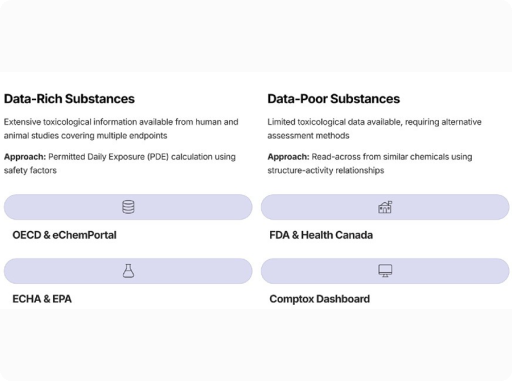
A comprehensive review of available literature on chemical substances is required. This includes an evaluation of two primary types of data data-rich substances and data-poor substances as defined in Figure.
Management of extractables and leachables is a life cycle activity extending from early development through product commercialization and post-approval change management.
Life cycle management includes periodic reassessment of packaging materials, monitoring of leachables during stability studies, and evaluation of potential impacts resulting from manufacturing changes. A structured life cycle strategy ensures continued compliance with regulatory expectations and maintains product safety throughout the product's market life.
An integrated workflow for extractables and leachables assessment typically includes the following steps:
1. Risk assessment of packaging components
2. Extractables characterization studies
3. Identification of potential leachable candidates
4. Analytical method development
5. Leachables stability studies
6. Toxicological safety evaluation
7. Lifecycle monitoring and documentation
Implementation of such a workflow provides a systematic approach for controlling E&L risks.
A practical example involves evaluation of extractables from a rubber stopper used in a parenteral vial system. Extraction studies using aqueous and organic solvents identified several potential extractable compounds including antioxidants and polymer degradation products. Subsequent leachables studies conducted during stability testing confirmed the presence of two compounds above the analytical evaluation threshold. Toxicological evaluation demonstrated that patient exposure remained below established safety thresholds, supporting continued use of the packaging component. This example illustrates the value of integrating extractables and leachables studies with toxicological evaluation.
Several regulatory and pharmacopeial guidelines provide recommendations for extractables and leachables assessment. These include:
• ICH Q3E – Extractables and Leachables
• USP <1663> – Assessment of Extractables Associated with Pharmaceutical Packaging
• USP <1664> – Assessment of Drug Product Leachables
• PQRI Safety Thresholds and Best Practices
These documents provide complementary guidance for implementing comprehensive E&L control programs.
Extractables and leachables represent a critical component of pharmaceutical product quality and patient safety. Implementation of the ICH Q3E guideline provides a harmonized framework for systematic evaluation and control of these impurities. A holistic strategy integrating risk assessment, analytical science, toxicological evaluation, and life cycle management is essential for effective E&L control. Adoption of such approaches enables pharmaceutical organizations to ensure regulatory compliance while maintaining robust product quality systems and protecting patient safety.
Q3E Guideline for Extractables and Leachables
Risk Assessment of the Leachables' Profile for Small-Molecule Pharmaceutical Drug Substances
Assessment of Extractables Associated with Pharmaceutical Packaging/Delivery Systems
For more information contact:
Bhupatsinh Vihol, Ph.D.
Deputy Director Analytical Development
Piramal Pharma Solutions
Piramal Pharma Solutions (PPS) is a Contract Development and Manufacturing Organization (CDMO) offering end-to-end development and manufacturing solutions across the drug life cycle. We serve our customers through a globally integrated network of facilities in North America, Europe, and Asia. This enables us to offer a comprehensive range of services including drug discovery solutions, process and pharmaceutical development services, clinical trial supplies, commercial supply of APIs, and finished dosage forms. We also offer specialized services such as the development and manufacture of highly potent APIs, antibody-drug conjugations, sterile fill/ finish, peptide products and services, and potent solid oral drug products. PPS also offers development and manufacturing services for biologics including vaccines and gene therapies, made possible through Piramal Pharma Limited's associate company, Yapan Bio Private Limited.
.png "global image")